

Germany's Curtailment Shift: Why Storage Changes the Economics

Germany’s proposed Grid Package (Netzpaket) introduces a major shift for renewable energy developers. Specifically, the Redispatchvorbehalt (redispatch reservation), a provision in the draft that leaked in early February 2026, changes the financial dynamics of building in highly congested areas.
Under this new rule, redispatch compensation (the fee paid to generators for curtailed energy) can be waived for newly built projects in these congested zones. This means asset owners, rather than the network operator, would bear the full financial exposure and curtailment risk. Moving forward, network operators will be able to flag capacity-limited grid elements where more than 3% of the technically possible feed-in from connected plants was curtailed in the previous year.
Which regions in Germany face the highest curtailment risk?
With this regulatory shift, site selection becomes absolutely crucial for a project’s bankability. SMARD data reveals exactly where that curtailment risk is most concentrated: the wind-heavy north (Lower Saxony, Schleswig-Holstein and Brandenburg) and the solar-heavy regions of Bavaria.
.gif)
This uneven distribution of grid congestion is exactly where granular, project-level modelling pays off. With Gridcog, developers can assess multiple sites across Germany's four control zones, estimate potential curtailment volumes in each zone and test whether adding a Battery Energy Storage System (BESS) can shield the project from those losses, turning otherwise-wasted energy into a revenue-generating asset.
How does adding battery storage change the economics?
To estimate the actual impact of curtailment on a solar plant in southern Germany, a region where the grid is frequently congested due to high solar generation, we modelled three scenarios with varying curtailment hours. The number of curtailment hours was defined based on typical solar generation profiles and historical curtailment data reported on the Netztransparenz website.
First, we identified the hours that account for the top 80% of each month's solar generation. We then mapped which of those specific hours and months experience the highest curtailment of renewables (see the heat map below).
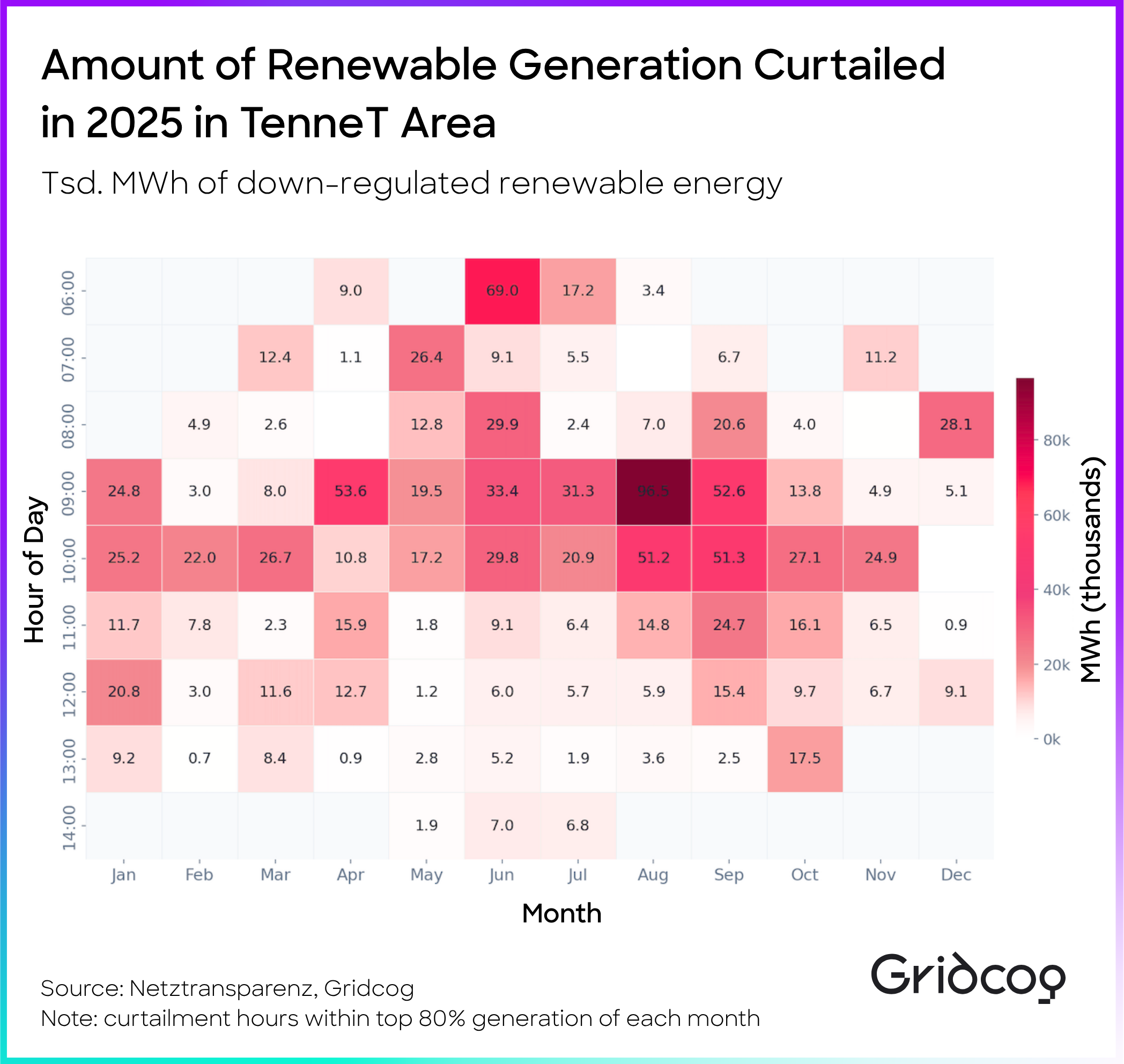
Based on the highest available curtailment and solar generation data, we defined three schedules for 2025: 1160, 884 and 669 curtailed hours, corresponding to 83%, 74% and 64% of total curtailment volumes respectively.
These schedules were applied to a modelled 100 MW standalone solar project, as well as a co-located project paired with a green BESS asset, to compare performance across different curtailment levels.
How much revenue could your solar plant actually lose?
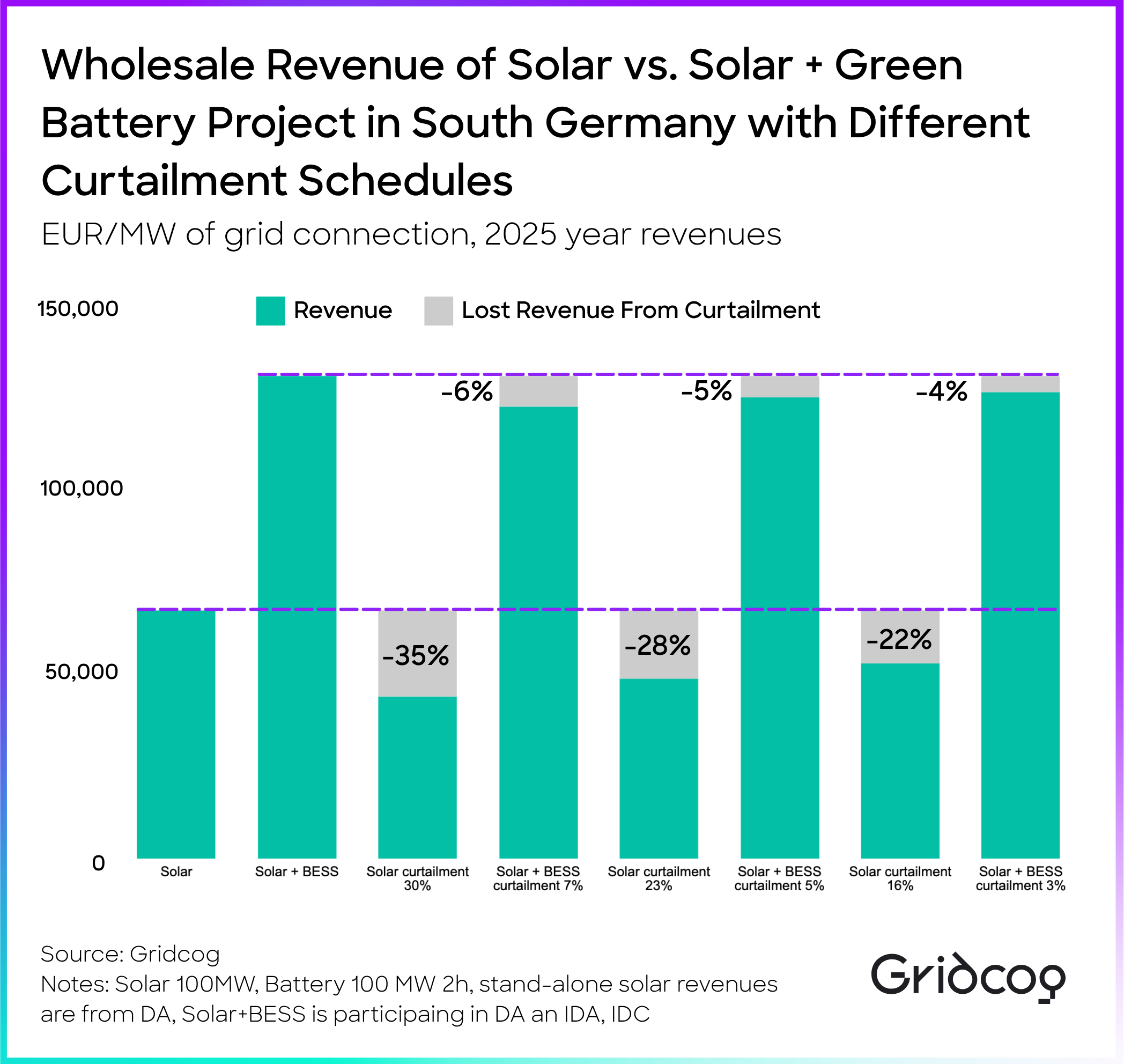
The impact on standalone assets is severe. The curtailment schedules we tested resulted in roughly 30%, 23% and 16% of generated solar being lost. Consequently, this curtailment led to wholesale revenue losses of up to 35% for a standalone solar plant.
Beyond wholesale losses, an EEG-supported plant would also lose a portion of its subsidy whenever curtailment occurs during hours of positive pricing. In our highest-curtailment schedule, the defined curtailment hours overlapped with 20% of the solar generation hours that fell during positive-price periods.
Here is where storage changes the equation. In every scenario modelled with a battery, the co-located setup proved far more resilient. Even without an import connection, the BESS was able to absorb much of the curtailment impact, limiting revenue losses to a maximum of just 6% compared to the uncurtailed baseline.
How can you protect your next project?
If your network operator reports that your new renewable project is located in a highly congested zone, you risk being curtailed without compensation under the new Redispatchvorbehalt rules.
You can protect your investment by testing the potential impact of these regulations early. Explore the specific scheduling in your target zone and accurately model the economics of adding co-located storage using Gridcog. Get in touch with the team here.


.jpg)


