

Optimising energy for UK data centres: grid, hybrid, and microgrid approaches
.jpg)
What are the key energy challenges facing data centres?
As data centres scale to meet accelerating AI, cloud computing and digital infrastructure demand, one of the earliest and most consequential decisions is how they connect to the electricity grid and secure long-term energy supply.
This challenge is becoming more acute. In Europe and the UK, energy demand from data centres is expected to increase by more than 150% by 2035. At the same time, in established data centre hubs such as Slough and Dublin, grid congestion and electricity network constraints are already severe. Connection capacity is limited, approval timelines are long - often up to 13 years - and in some cases policy is actively restricting new connections.
Developers are increasingly facing a simple reality: a large, firm grid connection is no longer guaranteed, and even when it is available, it may take years to secure.
Watch Josh’s Thinking Energy video where he dives into this topic and creates a model in GB to explore how data centres are overcoming these grid constraints. Read on if you’d like to see additional examples in GB and Australia.
Modelling energy supply options for a UK data centre
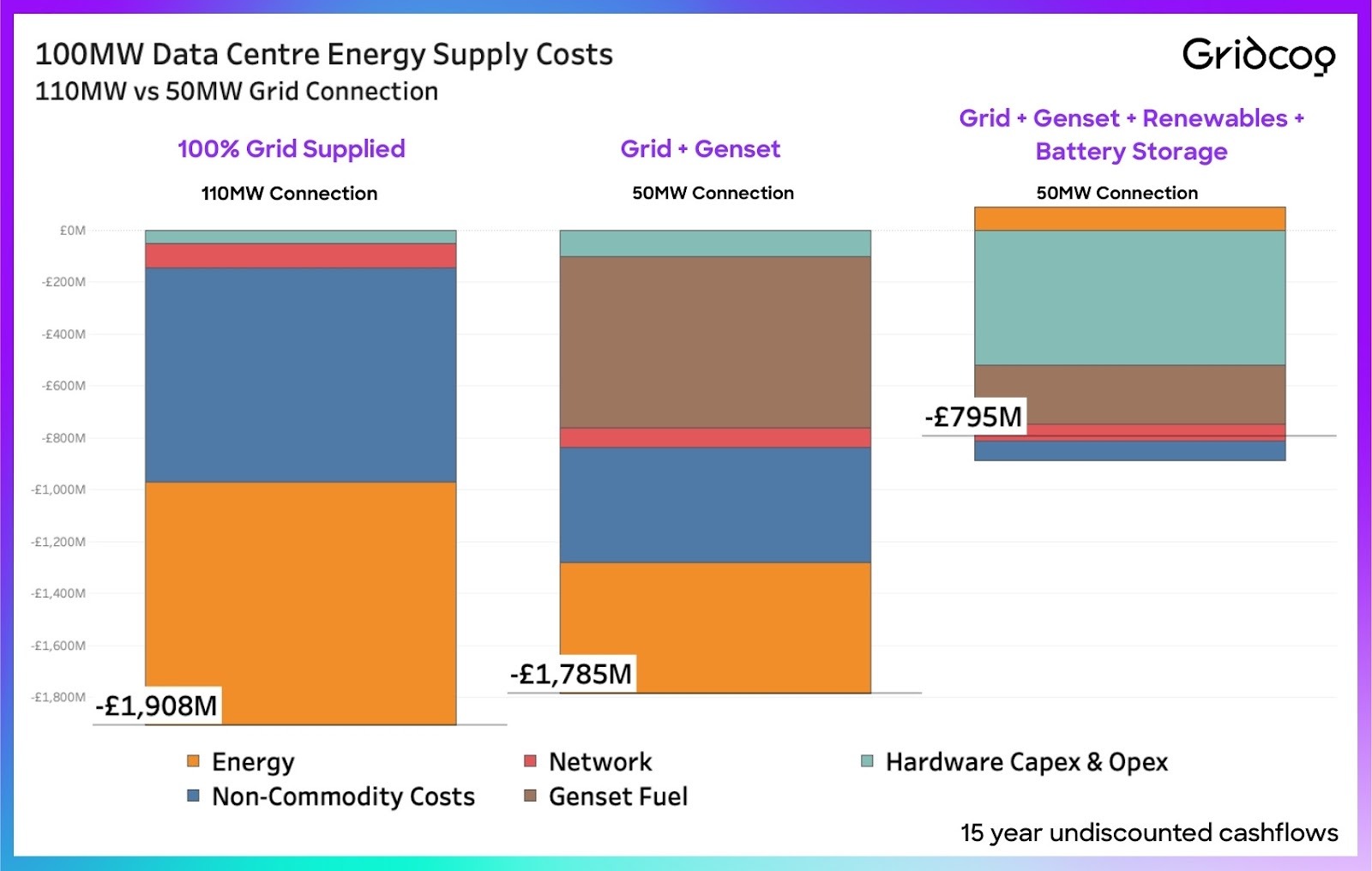
To explore what this means in practice, we used Gridcog to model and compare a range of energy supply approaches for a hypothetical hyperscale 100MW data centre located in Slough in the UK.
Option 1: Fully grid-supplied energy
A fully grid-supplied approach, modelled at £1.9 billion over 15 years, is operationally straightforward but often difficult in practice.
A shortage of available grid capacity, long lead times for connection approvals, and high upfront infrastructure costs mean this option is increasingly constrained. In many cases, developers may not be able to secure this type of connection at all, or at least not within project timelines.
Option 2: Smaller grid connection with onsite thermal generation
Adding on-site firm generation for primary energy supply, not just for back-up power, is gaining significant traction across the data centre sector.
Here we’ve modelled a hybrid configuration combining a reduced grid supply with a 50 MW gas genset. This reduces lifetime costs to £1.79 billion, whilst also easing pressure on the local electricity network.
Although gensets carry carbon and fuel price volatility risks, they provide a practical buffer where grid reinforcements are slow, expensive, or uncertain. This approach helps operators secure power earlier and with more control over project delivery timelines.
Option 3: Smaller grid connection with onsite renewables, battery storage and thermal generation
A more transformative option is a microgrid-style energy portfolio of solar, wind, battery storage, grid import, and genset capacity.
This integrated configuration reduces whole-life cost to £795 million and mitigates grid connection risk by supplying a large proportion of energy onsite.
The final asset sizes are big and definitely will not be everyone’s cup of tea, with 124 MW of solar, 259 MW of wind, and 70 MW of storage. However, it illustrates how distributed and diversified energy generation can both decarbonise operations and materially reduce reliance on costly grid upgrades.
What do grid constraints look like for data centres in Australia?
This shift is not unique to the UK.
In Australia, for example, new hyperscale developments are already being offered partially firm and partially flexible grid connections. In one case, a proposed 400MW data centre was only offered 300MW of firm capacity, with the remaining 100MW required to be flexible.
This kind of constraint is likely to become more common globally.
To explore how manageable this is, we modelled a similar large-scale data centre connected to a constrained network, testing scenarios ranging from fully grid-supplied with no flexibility, through to genset-backed supply, and finally to large behind-the-meter renewables and storage.
In these simulations, “system stress events took two forms:
- Physical constraints: reduced network capacity during peak periods
- Economic signals: high wholesale price events
The attached graphics provide a comparison of energy supply costs for each scenario over 15 years, and a zoom-in on the energy flows for a single week of the simulation where flex is required for both physical and economic reasons. I've focussed on the genset scenario simply as it makes for a cleaner graphic.
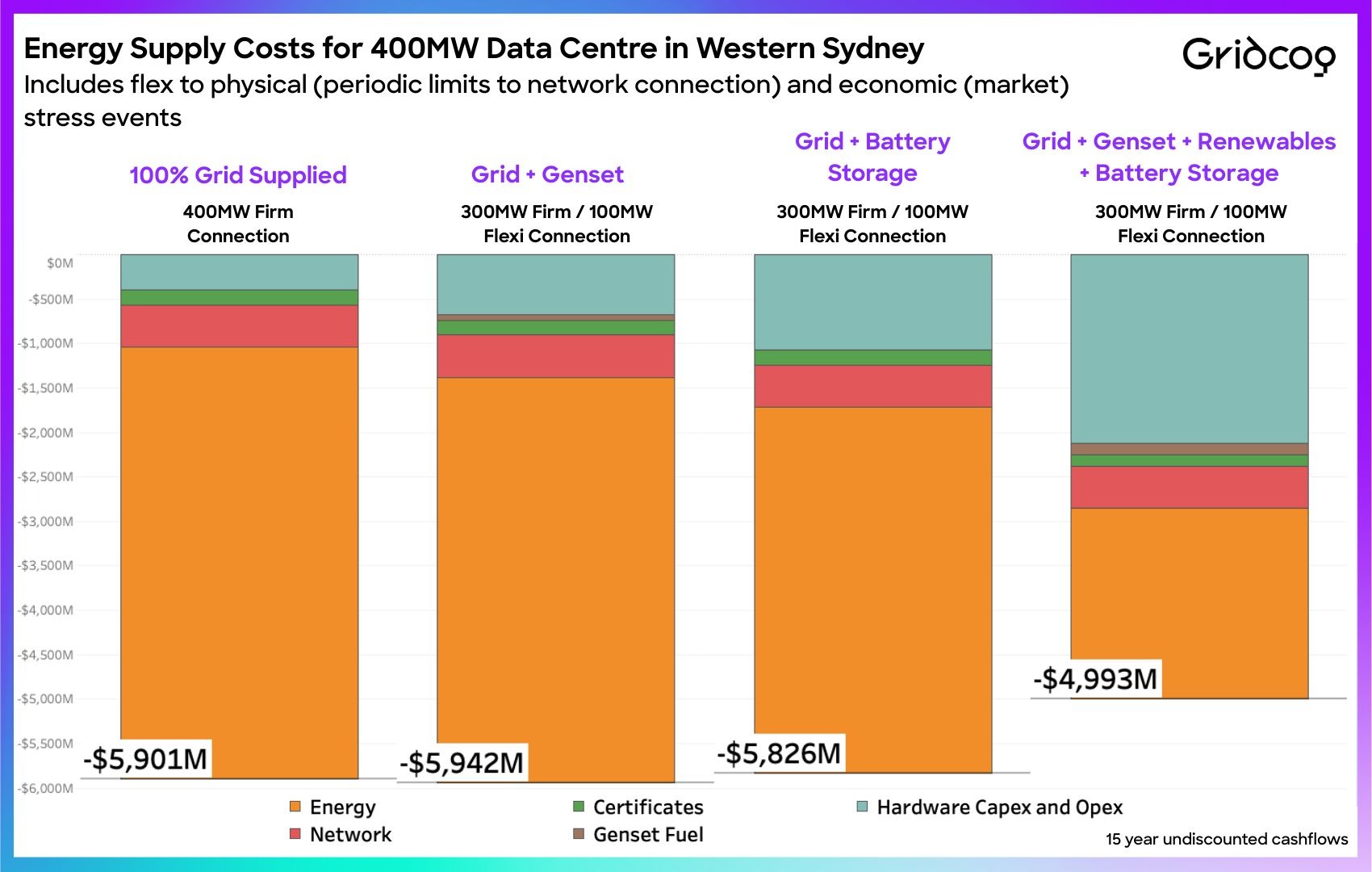
In both situations, the data centre needed to reduce its reliance on the grid.
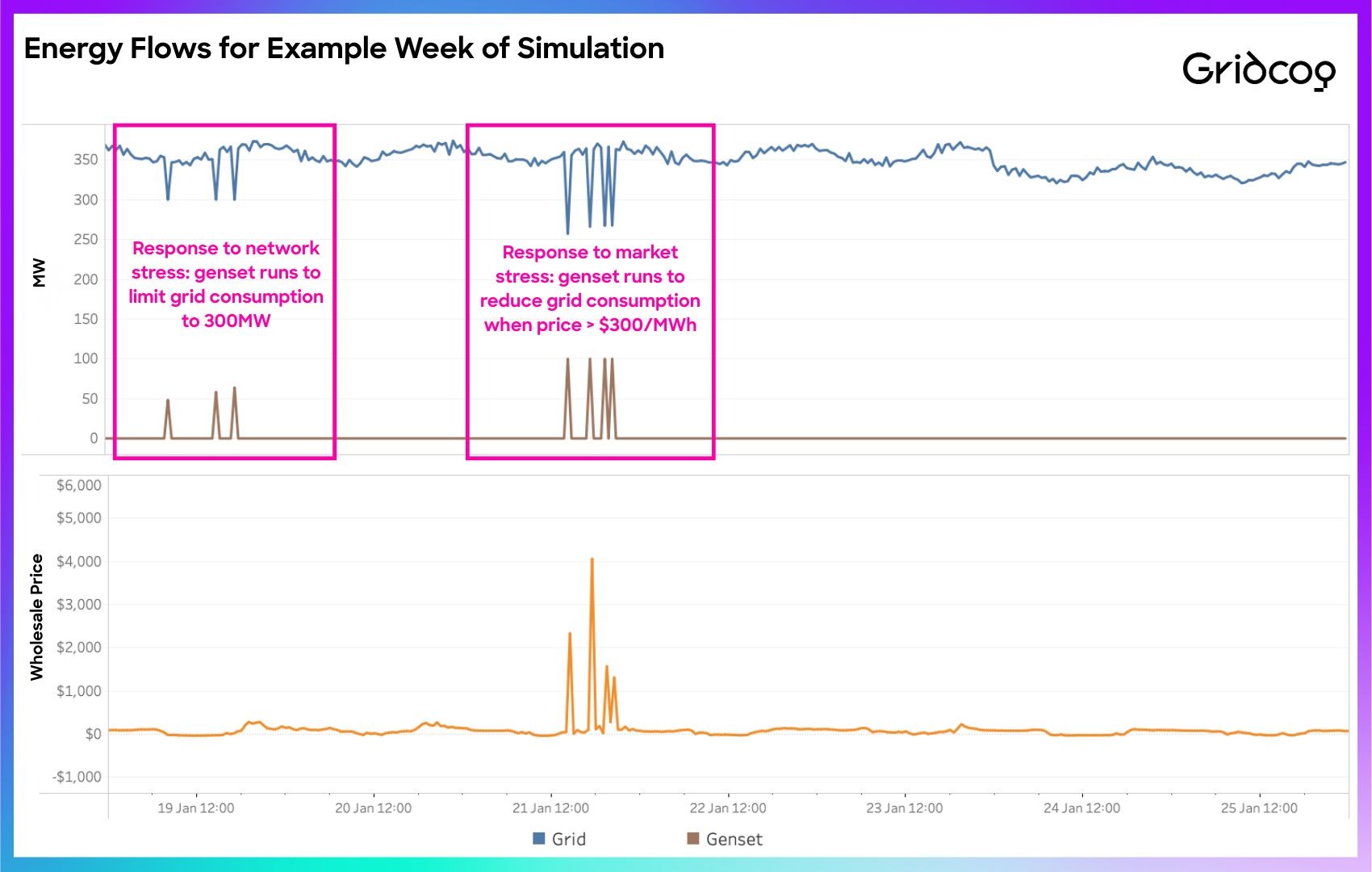
The outcome is fairly clear. Whether driven by physical limits or market signals, large data centres will increasingly be expected to be flexible, or to take greater responsibility for their own energy supply through hybrid or microgrid-style solutions.
Why must data centres rethink energy strategy in constrained grids?
Data centres are no longer simply buying power.
They are being required to actively participate in addressing grid congestion and connection constraints, either by reducing their reliance on the grid or by offering demand flexibility during system stress events.
This fundamentally changes how energy strategy needs to be approached. Instead of a single connection decision, developers are now evaluating portfolios of supply options that balance:
- Cost
- Reliability
- Carbon outcomes
- Speed to energisation
- Exposure to market volatility
For some, that will mean hybrid solutions with thermal generation. For others, it will mean large-scale investment in renewables and storage. Increasingly, it will mean some combination of both.
If you’re a data centre developer, or a renewables project developer looking to secure long-term offtake agreements from data centre owners, and need some help understanding your options, then hit up the Gridcog team.


