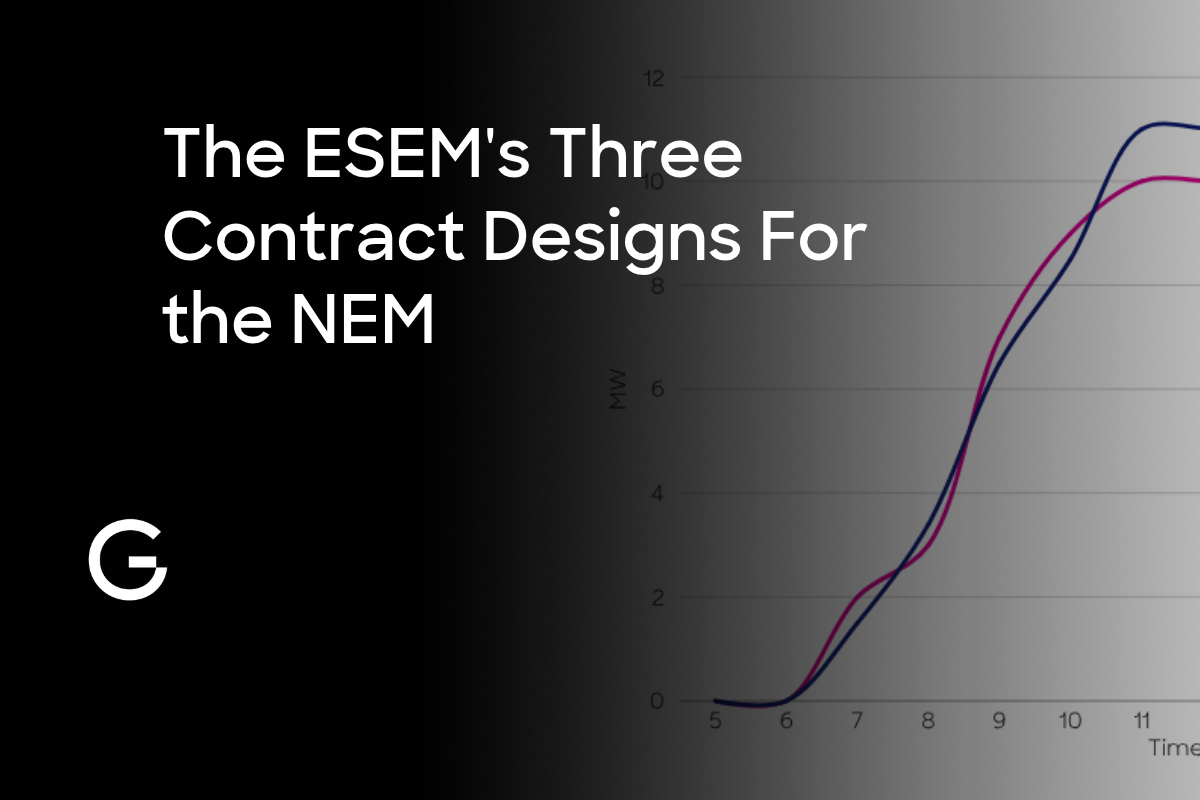
The ESEM's Three Contract Designs For the NEM
The Electricity Services Entry Mechanism (ESEM) will be the Australian National Electricity Market’s (NEM’s) enduring government support mechanism for investment in new generation and storage capacity, replacing the Capacity Investment Scheme (CIS) as it winds down. Pilot ESEM tenders could occur from the start of 2027, the first tender anticipated late 2027.
The ESEM is designed to bridge the “tenor gap” between the long-term revenue certainty projects need to secure financing and the shorter periods over which retailers and C&I buyers are willing to contract. The ESEM Administrator (ESEMA) will “warehouse” those short-term contracts until they are contracted back. To be eligible, projects must be at least three years post-COD, and sold into a reverse auction with the ESEMA.
Whilst the contract structures are still being finalised, we know they will cover three services: Shaping, Bulk Energy and Firming. Each is procured through its own tradeable contract, and each addresses a different part of the load-match problem: the daily price spread, volume, and extreme price events.
Shaping: The Dynamic Time of Day Block Spread Swap
Description: This shaping service answers the intraday price spread with the top/bottom (TB) spread contract (also called Heads & Tails). The TBx pays out on the difference between a strike price and the daily spread between the highest and lowest-price windows, as we detailed in our battery storage offtake bankability article.
Settlement = Contracted Volume x (Fixed price – Realised Spread in the ex-ante window)
A standard TB spread is usually settled ex-post on whatever the top and bottom periods turned out to be on the day. This ToD Block Spread Swap works by selecting the settlement window ex-ante. The index used is AEMO's day-ahead residual demand forecast (operational demand minus forecast VRE), which sets the charge and discharge windows at 4pm the day before.
The window runs from 9am to 9am the next day, and the product can carry up to two charge and two discharge blocks a day, each with a length of at least 30 minutes. Settlement is weekly, ex-post, against actual spot prices inside those pre-agreed windows. What the battery physically does doesn't come into it: the seller dispatches however it likes, and the swap only cares what spot price was inside the windows nominated the day before.
Mechanism:
- The intervals for the spread are selected one day ahead.
- The residual demand forecast is the proxy used to select the windows for the spread.
- The spot price within these windows is used for the settlement.
.png)
Bulk Energy: The Regional Reference PPA
Description: The bulk energy service responds to the volume-matching procurement problem via a contract similar to a proxy volume index swap: the Regional Reference PPA (RRPPA). It is a financial contract that has its settlement volume tied to an external volume shape.
The settlement volume isn't the seller's own output, but a Reference Production Index (RPI). The RPI is the reference fleet's actual generation divided by its capacity, with each project’s weight capped, so that a single, high generating farm, doesn’t dominate the index. The reference fleet is every operational asset of a given technology (wind or solar) in a region with a nameplate capacity above 30MW.
Mechanism: In a conventional PPA, the notional volume is the farm's own metered output. In the RRPPA, the notional volume in each trading interval is the RPI multiplied by the contract capacity (MW), and by 5/60 to convert the five minute figure into MWh.
.png)
This is what the contract will settle on for the seller:
Settlement = Notional Volume × (Strike Price − Spot)
where notional volume = (Reference Power Output ÷ Reference Power Capacity) × 5/60 × Contract Capacity
The intent is to swap the seller's individual volume risk for the fleet's systemic volume risk. A farm that beats the reference fleet keeps the upside. One that underperforms the index wears the downside, but at least isn't defending a fixed volume regardless of the weather, which is the bankability problem with fixed volume swaps for variable renewables.
Firming: The $600 Cap
The firming service defends against extreme price volatility. The structure of the contract is the most conventional of the three: a standard cap, struck at $600/MWh, aligned to the current Administrative Price Cap. The buyer pays a fixed premium and is insured against spot prices above $600/MWh. The seller keeps the premium and any merchant revenue below the strike, but owes the buyer the difference whenever spot price clears above it.
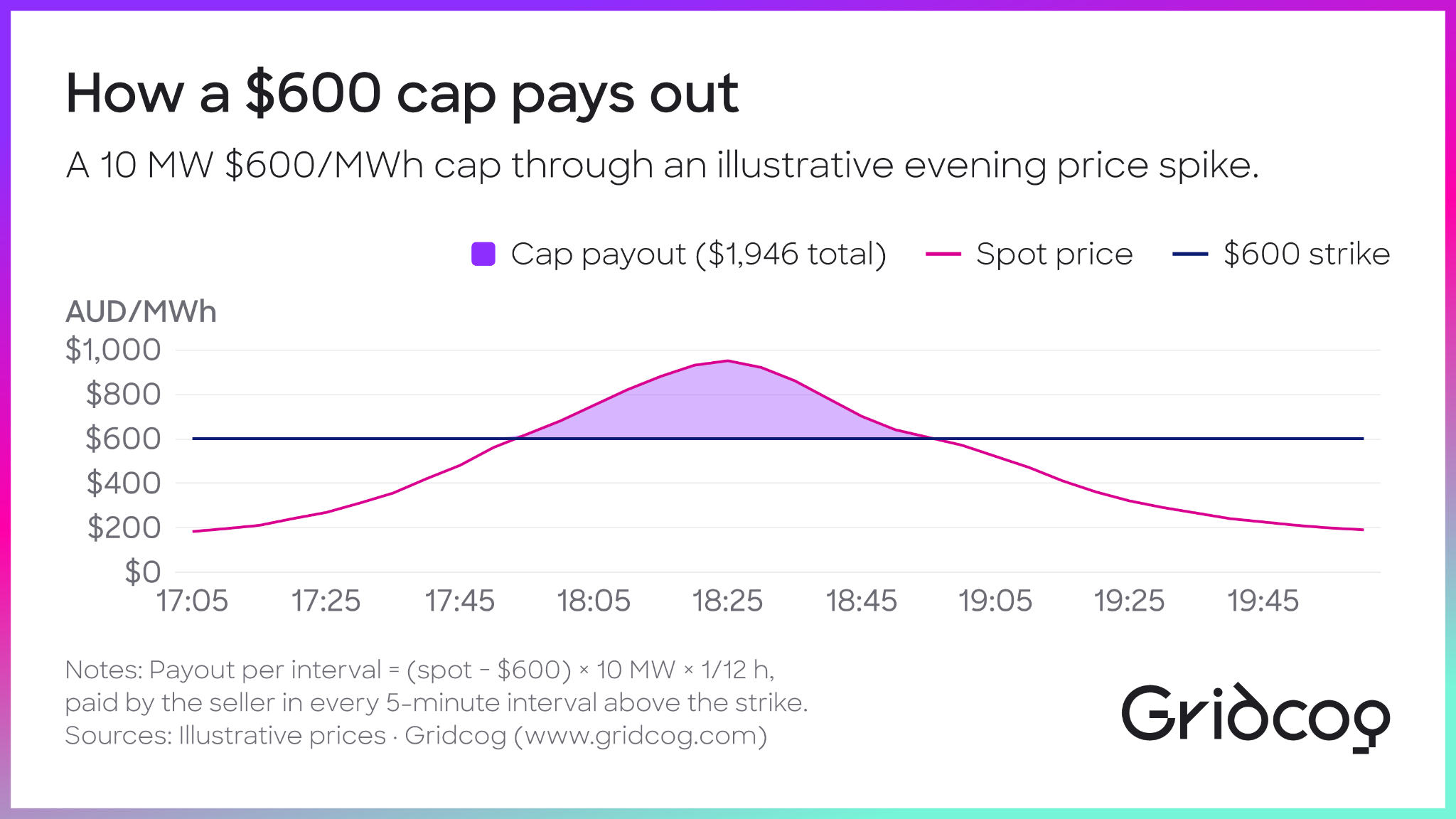
Cap contracts are already well established in the NEM, so the main design choice here is the premium rather than the structure. A $600 cap lets sellers retain more merchant upside than a lower strike would, which is expected to reduce the premium buyers pay while still protecting them against extreme price spikes.
Everything else about the cap follows the standard shape: weekly settlement against the AEMO calendar, with no physical performance obligation (it's a financial instrument, not tied to a specific plant). Force Majeure risks are external to this contract, and sit with the seller.
Where This Leaves Things
None of these three are finished designs, and there are still a few open questions.
With a cap, the main design question is where to set the strike price. A lower strike gives the buyer more protection against high prices but means paying a larger premium, while a higher strike is cheaper but only pays out during more extreme price events.
With a shaping swap, the more interesting question is how to protect buyers when the residual demand forecast doesn't match the actual shape of spot prices, and whether the product is strong enough to compete with virtual offtake agreements.
With a reference PPA, the questions are which index to reference and how much basis risk the seller really takes on once its own generation and price profile diverge from the fleet's.
Modelling Contracts in Gridcog
Gridcog makes it easy to model these trade-offs, including comparing a site's location and output against the reference production index.
In the chart below we have compared in Gridcog two solar farms of the same sizing, located in North and South Queensland. The same RRPPA contract has been modelled for both projects, yet cashflows for each site vary significantly. This is because the contract’s strike price is settled against the capture price from the state’s reference fleet output, not the modelled solar farms.
Because the two solar farms have different dispatch strategies and constraints, their total captured revenue differs. Settled against the same strike price, the site with the strongest performance keeps more of that upside, while a site that underperforms the reference fleet will be impacted by that shortfall.
.png)
If you’d like to explore the impact of contracted revenues on your project’s commercial attractiveness and bankability, reach out to the Gridcog team.