

Flexible Grid Connections for Data Centres: GB & Ireland
Britain's demand connection queue grew from 41 GW to 125 GW in the space of seven months, and Ofgem attributes at least 80 GW of that increase to data centres. This on a system whose current peak is around 45 GW. Ireland is even more constrained, with data centres already accounting for 23% of metered electricity (CSO) and greater Dublin closed to new connections since 2021.
For data centres (and other large loads), guaranteed capacity is hardest to find near fibre routes and existing substations, which is where the network is already at its limit. Flexible connections are a current solution, but site viability depends on how much advance warning the operator gets before reducing power. Planned load reductions are simple to schedule, whilst an unannounced one - or a quick response reduction requirement - has to be covered by generation or storage held in reserve, and that comes at a cost.
What’s a flexible connection, and why are data centres looking at them?
A firm connection allows a site to draw its full contracted capacity at any time, and obliges the network operator to build whatever reinforcement is needed to make that possible. It is that reinforcement which accounts for most of the delay.
A flexible connection removes this obligation. Capacity is available for most of the year but not all of it, the grid operator decides when it isn't, and in return the site connects earlier and pays less for the connection itself.
Data centres are well suited to this flexible arrangement, since backup generation, such as gas or diesel generators, and battery storage are already incorporated into the site for resilience purposes, and the same equipment will cover a curtailment event - as readily as an outage. In Ireland the decision has largely been made for data centres, because European law now obliges the regulator to make flexible arrangements available wherever capacity is short.
The flexible connection options available in GB and Ireland
There are a number of flexible connection options available to data centre developers in GB and Ireland:
Timed/scheduled connections. The agreement states upfront which hours, days or seasons the site must stay below an agreed level, and both National Grid Electricity Distribution in GB and ESB Networks in Ireland offer versions of this. Because the timing and the volume are known in advance, maintenance and batched workloads can be planned around them.
Flexible now, firm later. The site connects to the grid early under restrictions, and converts to a full firm connection once reinforcement is complete. Ireland's flexible demand connections are built this way, European law requires a route to firm connection in most circumstances, and Ofgem is developing a version for GB in which contracted capacity steps up in stages.
Curtailment decided in real time. The most common flexible connection in GB is known in the industry as active network management. An automated control system monitors the local network and reduces the site's import whenever it approaches its limit, with limited advanced notice. Two caveats to this: sites are curtailed in the order they connected (i.e. newest first); and since a 2023 rule change there is a contractual ceiling on annual curtailment hours with compensation payable beyond it. Neither of these caveats applies to a Technical Limits connection, where the congestion sits on the transmission network. Ireland's equivalent is stricter again, allowing just two minutes to acknowledge an instruction and five to comply, with no ceiling and no compensation.
Bring your own generation. On-site co-location/standalone BESS power picks up the load whenever grid supply is reduced, so the facility itself sees no interruption. Ireland has made this mandatory: under the regulator's December 2025 decision, larger data centres must build dispatchable generation matching their contracted capacity, sell it into the wholesale market, and cover 80% of annual demand with new Irish renewables within six years. Compliance to this brings exemption from emergency curtailment, which leaves the most flexible load on the system connected on the firmest terms available.
Modelling flexible connection options
Modelling flexible connection options is a vital step in the pre-investment phase, and is one of the many features Gridcog is built to handle.
In Gridcog, creating a Site Import Schedule (via the UI schedule editor or interval data upload), and applying it in a project, will enable analysis of multiple flexible connection options.
For timed/scheduled connections, the schedule editor can be easily configured to reflect arrangements such as pre-agreed winter peak connection constraints.
Flexible now, firm later connections can similarly be configured, with the schedule relaxing month by month or year by year.
Curtailment decided in real time requires more randomisation, and so, to reflect this, interval data import schedules can be configured and uploaded to reflect real time curtailment randomness.
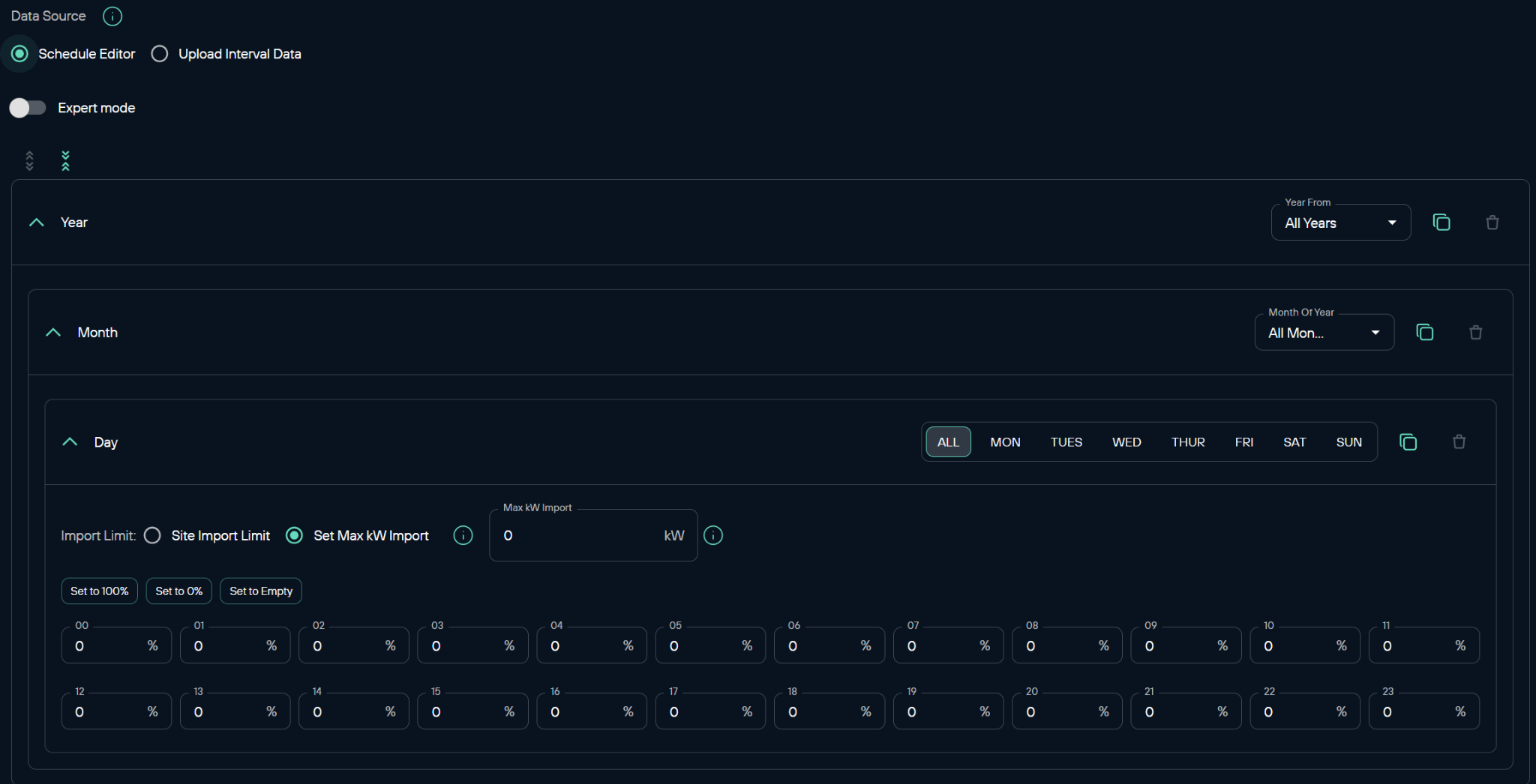
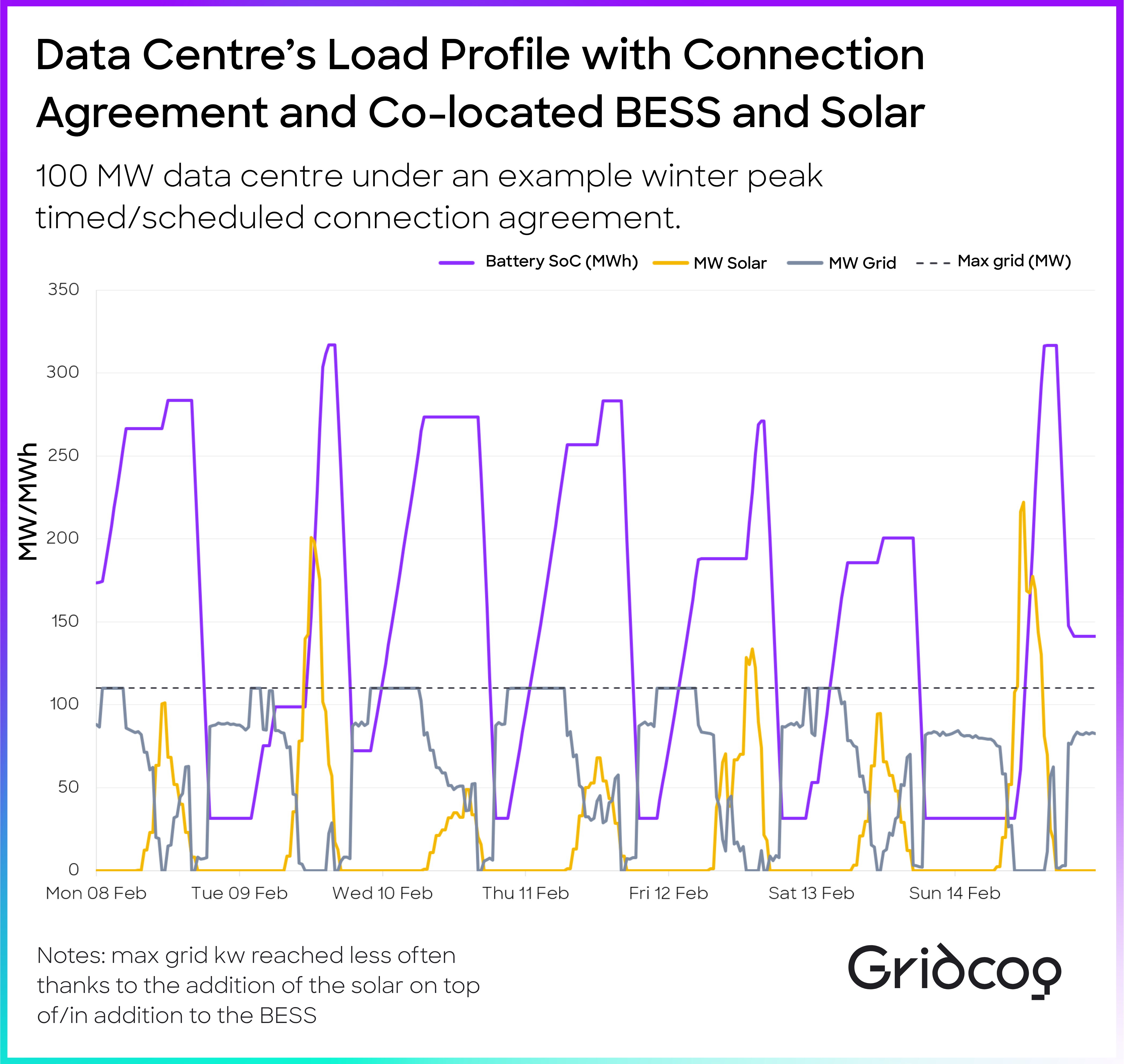
Bring your own generation situations generally occur in tandem with one of the aforementioned flexible connection options. To model this, I built a project in Gridcog with a 100 MW data centre under an example winter peak timed/scheduled connection agreement.
The three scenarios analysed are:
- A baseline case where the data centre has the connection agreement and no supporting generation;
- The introduction of a standalone BESS (sized using Gridcog’s autosizing feature);
- Co-located BESS & solar (again, sized using Gridcog’s autosizing feature).
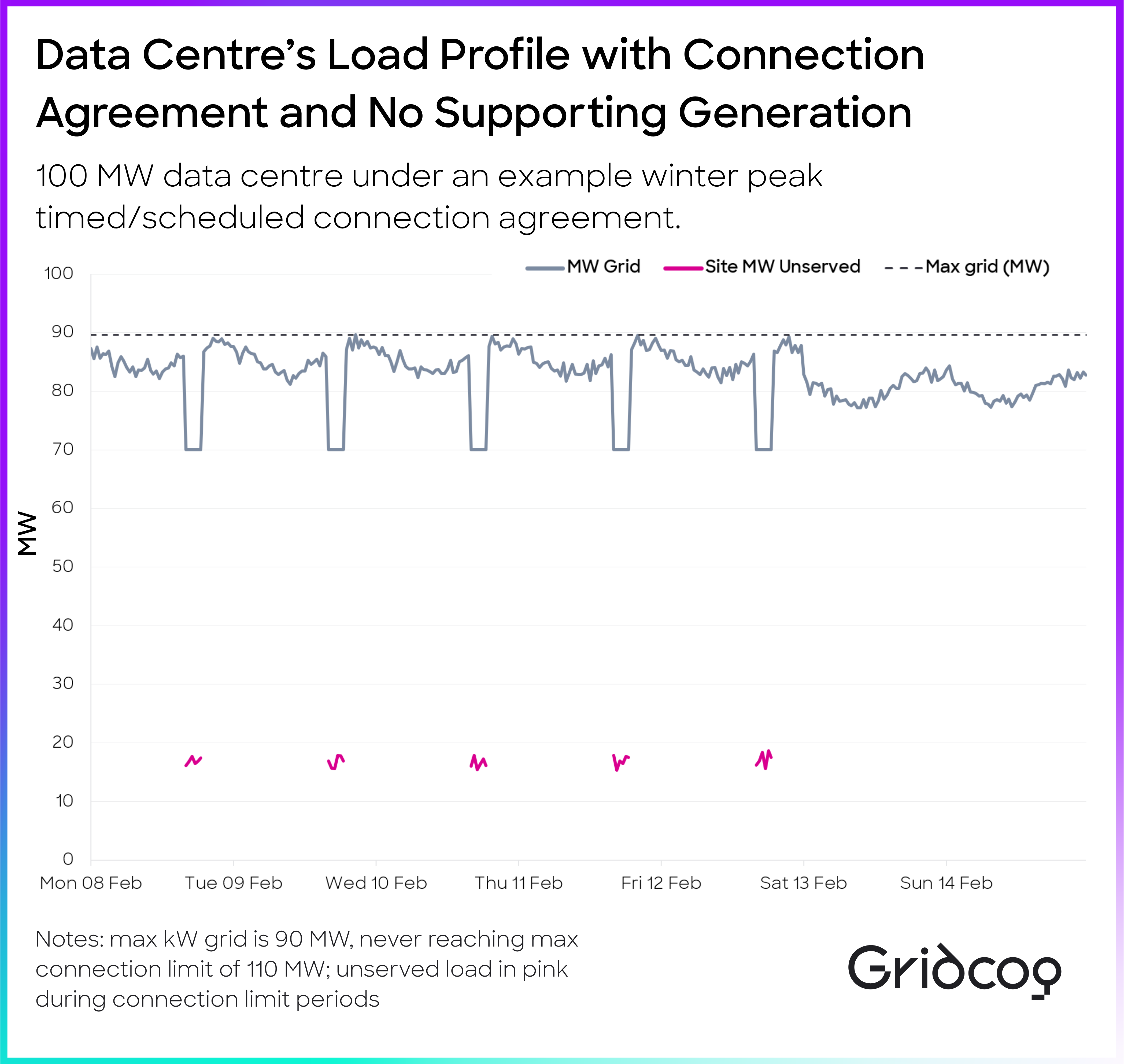
The figures below show an example week in winter, where the scheduled connection agreement comes into play. In the baseline scenario (Fig.1), the constraints during the evening peaks result in some significant periods of unserved load.
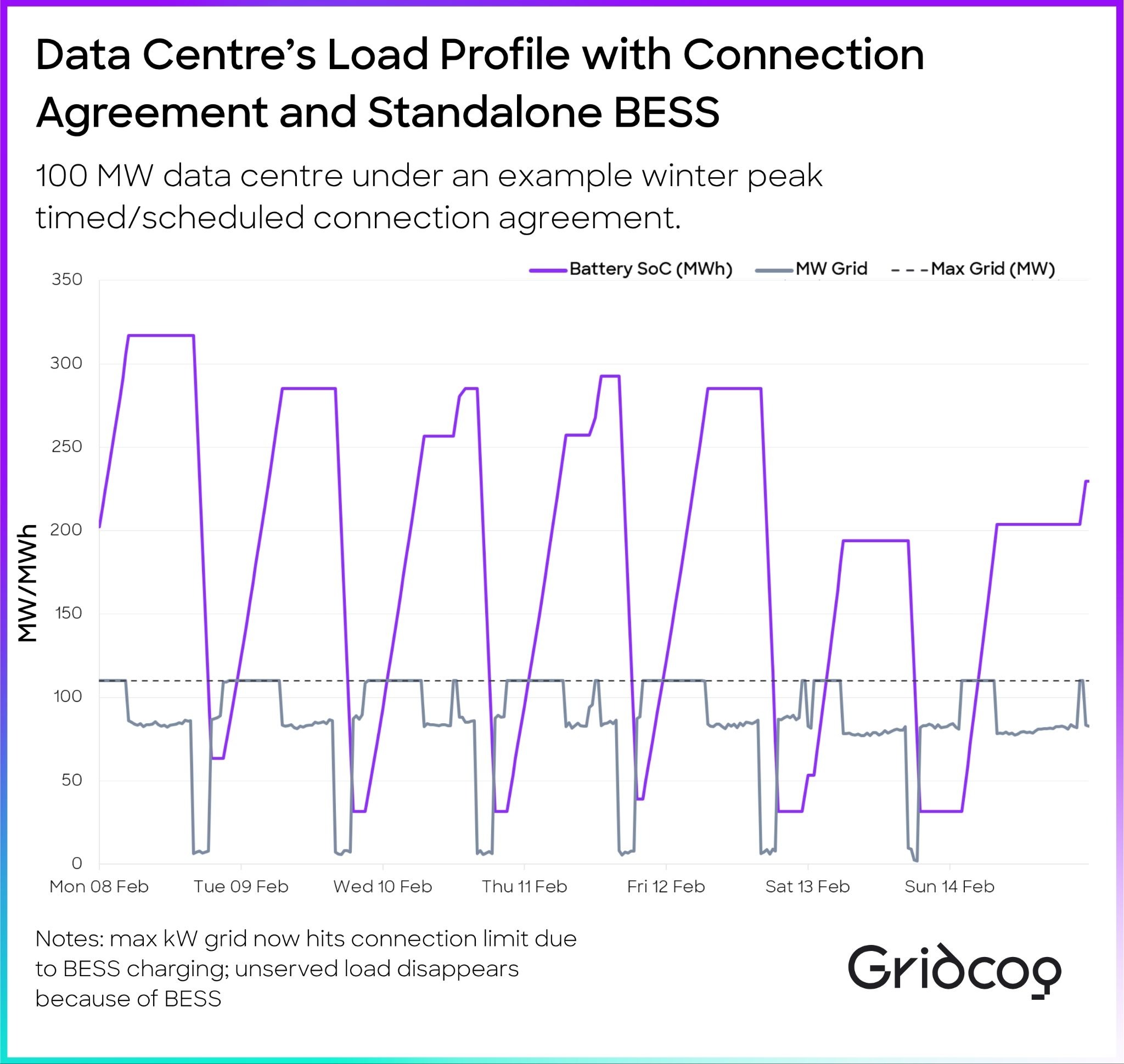
The introduction of the autosized standalone BESS (scenario 2) resolves these periods of unserved load. It charges during the cheaper midday periods (making full use of the site’s import limit) and then discharges during the winter peaks. Since these winter peak periods are both when the scheduled connection constraint is applied and also when network costs are at their highest, the BESS serves a double function of eliminating the unserved load and lowering grid import costs during those expensive periods.
The introduction of solar in the co-location scenario (scenario 3) builds on this. The BESS still discharges in the same intervals, however, some of this energy now comes from “free” solar. Consequently, this further lowers grid import costs.
What This Means in Practice: Curtailment Risk for a Load That Can't Afford Downtime
The impact of curtailment risk is generally smaller than developers anticipate, because the equipment needed to ride through a curtailment event is often already on site for resilience reasons. The real expenditure is the additional generation or storage required to ensure the data centre compute never drops, together with the fuel and cycling costs of running it.
Generally, those costs scale inversely with notice time. Timed connections are the cheapest to accommodate, since equipment can be sized against a known window and some load can simply be moved. Conversely, real-time curtailment costs more, because equipment has to cover a worst case rather than a timetable.
Key Takeaways for Data Centre Developers Evaluating Flexible Connections
The case for. Power arrives years earlier, the connection charge is usually lower, and most of the equipment needed to cope is already in the design. Where the connection date is the constraint holding a project up, that combination is normally decisive.
The case against. An arrangement with no ceiling on curtailment and no compensation offers no way to size the exposure, which makes it more difficult to finance.
Which arrangement suits which site:
- Workloads that can be shifted or batched: a timed connection, cheapest to work around and simplest to model.
- Significant on-site generation already committed: Ireland's route, or real-time curtailment in Britain, since the generation is being built regardless.
- Space let to a tenant on a firm service level: flexible now, firm later, with the conversion date written into the agreement.
- Uncapped and uncompensated arrangements: only where on-site cover is already funded.
Reach out to the team if you're interested in modelling large behind-the-meter loads or data centres in Gridcog.
-
FAQs: Flexible Connections for Data Centres
What's the difference between a firm and a flexible connection?
A firm connection guarantees full contracted capacity at any time, and the network operator must build whatever reinforcement that requires. A flexible connection removes that guarantee for certain hours or conditions, which means the site connects sooner and pays less, but has to plan around possible reductions.
What is active network management?
Active network management is the most common form of flexible connection in Great Britain. An automated control system monitors the local network in real time and reduces a site's import whenever it nears its limit, with limited advance notice. Sites are curtailed in the order they connected, newest first, and a contractual ceiling on annual curtailment hours applies, with compensation payable beyond it.
Is there a limit on how much a data centre can be curtailed?
In Great Britain, yes for most arrangements. Since a 2023 rule change, active network management connections carry a contractual ceiling on annual curtailment hours, with compensation due if that ceiling is exceeded. Technical Limits connections and Ireland's real-time curtailment arrangements carry no such ceiling and no compensation.
How much notice does a data centre get before curtailment in Ireland?
Very little. Ireland's real-time curtailment arrangement allows just two minutes to acknowledge an instruction and five minutes to comply, with no ceiling on hours and no compensation.
Do data centres in Ireland have to build their own generation?
Larger data centres do, under a December 2025 regulatory decision. They must build dispatchable generation matching their contracted capacity, sell it into the wholesale market, and cover 80% of annual demand with new Irish renewables within six years. Meeting this requirement brings exemption from emergency curtailment.
Which flexible connection type suits which data centre?
It depends on the load profile and what's already committed on site. Workloads that can be shifted or batched suit a timed connection, since it's the cheapest to plan around. Sites with significant on-site generation already committed suit Ireland's route or GB's real-time curtailment, since that generation is being built anyway. Sites let to tenants on a firm service level suit a flexible-now, firm-later arrangement with the conversion date written into the contract.
Can flexible connection scenarios be modelled before investment?
Yes. Gridcog's Site Import Schedule feature lets developers model timed, phased, and real-time curtailment scenarios, then layer in autosized BESS or co-located solar and BESS to see the impact on unserved load and grid import costs before committing capital.




.jpg)
