The Power of Flexibility for Data Centres in GB and Europe
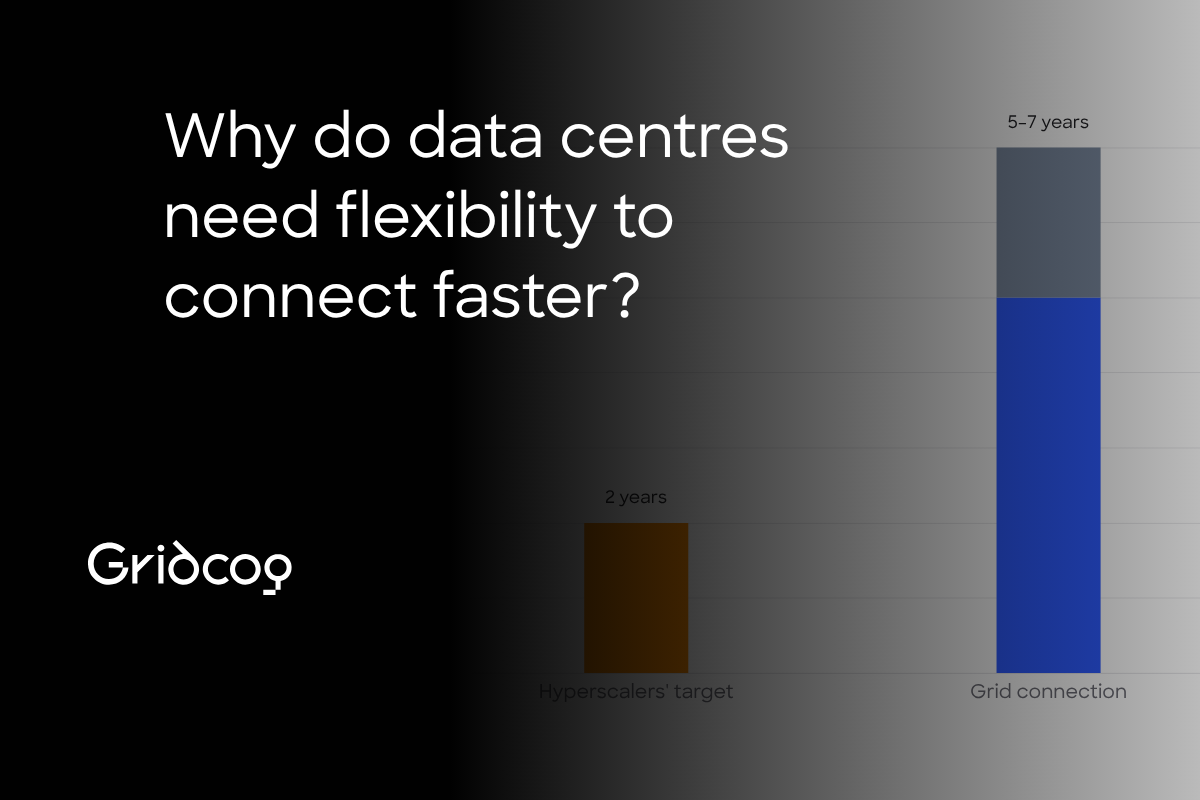
Grid connection timelines of 5–7 years are misaligned with hyperscalers’ plans to bring new data centres online within two years. Flexibility closes the gap: system flex solutions, such as non-firm and phased connections, and physical flex options, such as flexible compute, onsite generation and bring your own system capacity, let data centres energise sooner.
Key points
- Grid connection timelines of 5–7 years compare with expectations to bring new data centres online within two years (encoord, December 2025).
- About 140 data centres, representing roughly 50 GW, were in Great Britain’s demand connection queue (Ofgem, February 2026).
- Compute infrastructure alone costs around $50 million per MW, so operators need high utilisation (Financial Times).
- In a December 2025 trial at Nebius’s London data centre, Emerald AI and partners cut power demand by up to 40% while critical workloads ran as normal (National Grid).
- In Ireland, larger data centres must bring dispatchable generation and/or storage matching their maximum import capacity to connect (CRU, December 2025).
Why do data centres need flexibility to connect faster?
Hyperscalers are racing to build new data centre capacity across North America and Europe. But they’re coming up against a fundamental bottleneck: grid connection timelines of 5–7 years are completely misaligned with expectations to bring new facilities online within two years. The result is a growing industry focus on ‘speed to power’, with access to electricity increasingly determining where and how fast AI infrastructure can scale.
Figure 1: Grid connection timelines against hyperscalers’ target to bring a new data centre online. Source: encoord, December 2025.
The financial implications are enormous. Every MW of data centre capacity could represent US$4–12 million in annual value for tech giants [source], creating intense pressure to secure power quickly in order to train models, grow revenue, and justify lofty investor valuations.
What flexibility solutions are available to data centre developers?
Flexibility offers a solution by enabling earlier connection, allowing lucrative AI compute capacity to be energised more quickly through system-level interventions, which can be enabled by a variety of physical flex options.
| Option | Type | How it helps a data centre connect sooner |
|---|---|---|
| Non-firm or flexible grid connection | System flex | Connect faster in exchange for curtailing demand during system stress |
| Phased grid connection | System flex | Connection capacity scales up with build-out and ramp-up |
| Incentivising demand in the right locations | System flex | Site where renewable generation is abundant, ahead of network constraints |
| Flexibility in compute | Physical flex | Shift non-critical workloads across the day |
| Onsite generation | Physical flex | Behind-the-meter generation, renewables and BESS support earlier energisation |
| Bring your own system capacity | Physical flex | Contract additional clean capacity to match the new load |
Table 1: Flexibility options for data centres at a glance
System flex solutions
- Non-firm or flexible grid connections: Grid operators are increasingly considering non-firm connection arrangements, where large loads can connect faster in exchange for agreeing to curtail demand during periods of system stress (for example, transmission constraints).
- Phased grid connections: Connection capacity can scale up over time in line with data centre build-out and operational ramp-up, with many of the developers behind the roughly 50 GW of GB data centre demand waiting for connection welcoming this arrangement.
- Incentivising demand in the right locations: Effective policy and well-designed markets can incentivise data centre development where renewable generation is abundant and located ahead of network constraints, improving overall system efficiency – for example, in Scotland, with its abundant wind capacity.
Figure 2: Data centre demand in GB’s demand queue against peak demand. NESO’s demand queue call for input identified around 140 data centres (50 GW), of which 71 (around 20 GW) report a final investment decision. GB peak demand was 45 GW on 11 February 2026. Source: Ofgem, February 2026.
Physical flex options
- Flexibility in compute: Data centre economics are highly capex-intensive, with compute, power infrastructure, and cooling driving substantial upfront costs. With compute infrastructure (for example, GPUs and networking) alone costing around $50 million per MW, operators need high utilisation to spread these fixed costs across more compute hours. Despite this, most data centres are actually running at a 50–80% capacity factor [source]. Certain non-critical workloads, particularly AI training applications, which have yet to become widespread in the UK, can be flexed across each day, as demonstrated by Emerald AI and National Grid’s pilot in London. In this trial, critical workloads were maintained while demand was reduced by up to 40%, enabling rapid frequency response to intraday load shifting.
- Onsite generation: Behind-the-meter generation, ranging from fuel cells to conventional gas power plants, renewables and battery energy storage systems (BESS) can support faster data centre energisation, provide capacity during high-stress periods to the system operator and traditional flexibility services, such as reserve services.
- Bring your own system capacity: Data centre operators can contract for additional clean capacity through offsite renewable power purchase agreements (PPAs), BESS, and dedicated generation projects. This can help secure green supply, support system capacity, and demonstrate that new load is being matched with incremental generation and flexibility, with Ireland making this a prerequisite for connection.
Model your project in Gridcog
Why is flexibility the answer to data centre connection delays?
Flexibility is the only approach that can bridge the gap between hyperscalers’ two-year build ambitions and multi-year grid connection timelines. The winners will be developers that treat flexibility as a core part of their power strategy, combining phased ramp-ups and flexible connections, onsite generation (particularly BESS and solar) and flexible compute sited in the right locations to deliver faster, cleaner, and more resilient energisation.
Model your project in Gridcog
Frequently asked questions
What does speed to power mean for data centres?
Speed to power is how quickly a data centre can secure and energise its electricity supply. With grid connection timelines of 5–7 years against plans to bring facilities online within two years, access to electricity increasingly determines where and how fast AI infrastructure can scale.
What is a non-firm grid connection for a data centre?
A non-firm grid connection lets a large load connect faster in exchange for agreeing to curtail its demand during periods of system stress, such as transmission constraints. Grid operators are increasingly considering these arrangements for data centres. Our guide to flexible grid connections for data centres in GB and Ireland compares the options.
What is a phased grid connection?
A phased grid connection lets connection capacity scale up over time in line with a data centre’s build-out and operational ramp-up. Ofgem’s February 2026 call for input on demand connections reported clear developer appetite for phased or ramped connections in return for earlier connection dates.
Can data centres reduce their power demand on request?
Yes, for certain non-critical workloads. In a five-day trial in December 2025 at Nebius’s London data centre, Emerald AI, EPRI, National Grid, Nebius and NVIDIA cut power demand by up to 40%, including by more than a third in under a minute, while critical workloads continued to run as normal.
How many data centres are waiting for a grid connection in Great Britain?
About 140 data centres, representing roughly 50 GW, according to Ofgem’s February 2026 call for input. In July 2026, Ofgem said demand connection applications had grown from 41 GW to 125 GW in under a year, with data centre projects accounting for at least 80 GW.
What is bring your own capacity for data centres?
It means a data centre operator contracts for additional clean capacity, such as offsite renewable PPAs, battery storage or dedicated generation, to match its new load. In Ireland, the CRU’s December 2025 decision makes this a prerequisite: larger data centres must provide dispatchable generation and/or storage matching their maximum import capacity.
Can Gridcog model flexible connections for data centres?
Yes. Gridcog models dynamic and flexible grid connection agreements for large loads such as data centres, as well as for front-of-meter assets. You can add onsite solar, battery storage and generators to see the effect on unserved load, energy costs and emissions before you invest.
Sources
- encoord, Flexible Data Centers whitepaper, December 2025
- Ofgem, Call for Input: Demand Connections Reform, 13 February 2026
- Ofgem, Ofgem acts to free up grid capacity by tackling speculative data centre projects, 29 July 2026
- Financial Times, article on data centre compute costs [confirm title and date]
- National Grid, UK-first trial of AI grid technology successfully demonstrates the ability of data centres to adjust power needs, 2 March 2026
- Bloom Energy, Bloom Energy and Oracle expand strategic partnership to deploy up to 2.8 GW, 13 April 2026
- Aligned Data Centers, Aligned and Calibrant to deploy first-of-its-kind on-site battery storage project to unlock utility power for data centers, 22 October 2025
- Commission for Regulation of Utilities (CRU), CRU publishes its decision on new electricity connection policy for data centres, 16 December 2025