The Mechanics of Trading a Battery in the SEM

Key points
- Today's fleet is built for DS3 (i.e. regulated ancillary service payments, rather than a competitive market). Half the fleet is 30-minute assets; the pipeline is moving to 2–4 hours.
- Central dispatch and firm access: EirGrid has the final say on dispatch, and firm/non-firm access decides whether that dispatch adds or removes value.
- Thin liquidity: most wholesale trading happens day-ahead, which limits intraday repositioning.
- Potential for balancing market growth: 20,500 MWh accepted from July to October 2026, mostly energy actions.
- DS3 set to come under pressure: competitive DASSA procurement arrives in 2027.
On this page
- Ireland’s battery fleet is built for system services, not arbitrage
- Central dispatch changes who decides what your battery does
- Liquidity is thin beyond day-ahead but opportunities may lie ahead in balancing markets…
- Ancillary services: from regulated tariffs to competitive auctions
- Examples of the Mechanics of SEM Trading
- Conclusion
- FAQs
In my last article I explored the co-location opportunity in the Single Electricity Market (SEM): rising dispatch down, the regulatory barriers to sharing a grid connection, and the contracting structures that could make co-located sites bankable, from tolls and hybrid PPAs to offtake with data centres.
In this blog I want to go one level deeper and look at the mechanics of actually trading a front-of-meter battery in the SEM, and why it is a very different job to trading the same asset in GB or much of western Europe.
Ireland’s battery fleet is built for system services, not arbitrage
Ireland today has around 1.05GW of battery capacity, totalling 1.32GWh of storage. Around 50% of these assets are short-duration assets, with just 30 minutes of energy, built to capture high-value DS3 system services rather than wholesale spreads. For more information on the DS3, read my last blog here.
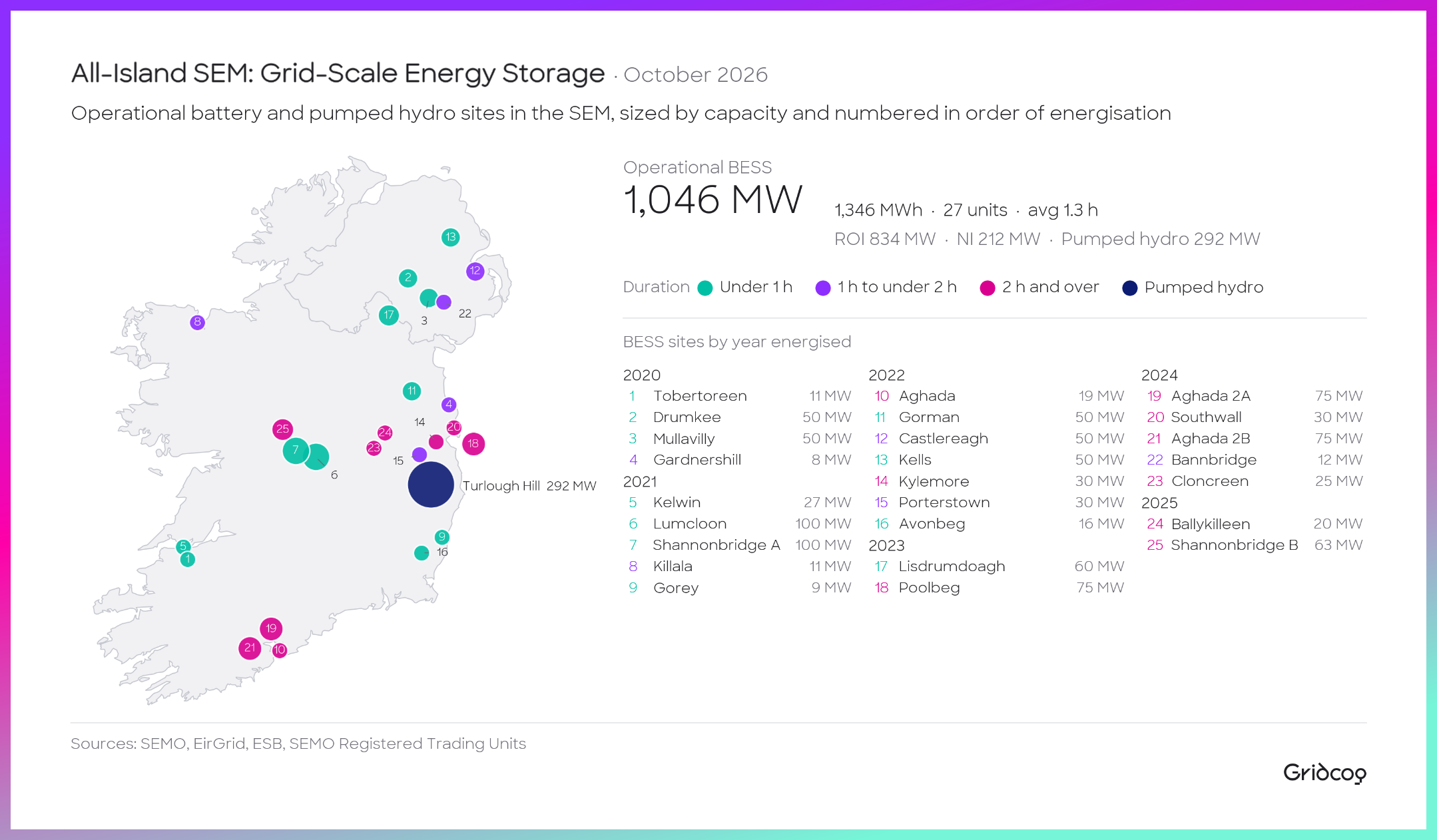
Figure 1: Ireland’s Current Energy Storage Fleet
The pipeline today looks very different. The majority of new projects are set to comprise 2 to 4 hours of storage, making up 42% and 38% of the pipeline respectively. These longer-duration assets are designed to capture the fundamental wholesale value created by renewables volatility, and to help relieve system and network constraints through the balancing market.
Figure 2: Ireland’s energy storage build-out to 2030 by duration
Central dispatch changes who decides what your battery does
The SEM operates a central dispatch model, unlike most of Western Europe, however this approach is widely adopted globally and used in Poland, Italy and Australia. EirGrid and SONI schedule and dispatch generation and storage in real time, based on security-constrained, least-cost merit order principles. Every unit submits its commercial and technical offer data, and the transmission system operators (TSOs) decide what it actually does. The submitted physical notification, PN, of energy assets, e.g. BESS, acts as a soft constraint within the centralised scheduling and dispatch that is carried out by the TSOs; this can be breached to allow the optimisation to find a solution.
GB for example works the other way round. Traders build a position across the day-ahead and intraday markets, then self-dispatch their charge and discharge profile for each settlement period through their Final Physical Notification (FPN).
In the case of GB, the Balancing Mechanism simply layers value on top: NESO pays for accepted bids and offers that move a unit away from its FPN, at prices the unit chose to submit alongside units keeping their wholesale revenues, with no imbalance exposure unless they deviate from their PN + BM position. A GB trader can therefore be confident that their wholesale strategy will be delivered physically or financially with the balancing mechanism providing upside.
Much like in GB, batteries in the SEM also set their initial positions in ex-ante markets (i.e. primarily wholesale and ancillary services as we move to FASS arrangements) with their Final Physical Notification (FPN) aligning with their ex-ante traded positions.
SDP-02, introduced in November 2025, actually enabled full wholesale market participation for batteries by allowing negative physical notifications to be submitted. All trading units greater than 10MW are also required to submit “inc” and “dec”s in the balancing markets, which offers value from deviating from their FPN based on energy and system needs. Note an inc is an increase in generation / reduction in demand compared to your plan submitted to the system operator, whilst a dec is a decrease in generation / increase in demand.
Additionally, and much like the Balancing Mechanism, a battery’s traded position can be overridden by dispatch instructions that differ from its notified position, when the TSOs’ schedule says the system needs are different. However, in the SEM this can lead to imbalance exposure, depending on connection type. That makes life harder for those optimising these assets as cycling strategies built around their traded positions may not be realised, for example if a battery is dispatched down.
For a dec, the assets pay the lower of the imbalance price and its dec bid. For incs, assets earn the higher of the imbalance price and their inc offer. The two types of connection in the SEM are firm and non-firm connections. When units are dispatched down, this categorisation determines how these assets are compensated with non-firm assets exposed to some potential downside driven by the imbalance price.
Liquidity is thin beyond day-ahead but opportunities may lie ahead in balancing markets…
Central dispatch is not the only constraint. Ireland has limited liquidity beyond the day-ahead market (DAM), which accounts for around 80% of SEMOpx traded volume. In October 2026, the liquidity per market looks like this:
Figure 3: Share of SEMOpx traded volume by market, October 2026
IDA1, clearing six and a half hours after the day-ahead gate, provides almost all of the remaining wholesale liquidity. Beyond that, the later auctions and the continuous market see very little volume. That makes it hard for batteries to reshape their position closer to real time as wind and solar output/forecasts become clearer, limiting upside from batteries’ inherent flexibility.
This also limits “churn strategies” that are well established in GB. The first is financial churn: buying and selling the same volume across successive markets to capture price movements, without cycling the battery at all. The second is physical churn: re-trading the battery’s actual schedule intraday as spreads move. Both rely on being able to trade volumes close to delivery.
The balancing market may be able to fill part of that intraday liquidity gap. From mid-July to the end of October 2026, accepted balancing volume from batteries was about 20,500 MWh. Most of it, 95%, was energy actions balancing supply and demand. The rest were system actions to ensure system stability. Today this volume is concentrated: three BESS (Shannonbridge B, Aghada, Poolbeg) sites took 60% of it. That should broaden as dispatch-down grows and more batteries adopt more merchant strategies instead of simply pursuing DS3 revenues.
Ireland could follow in the path of GB where the balancing mechanism is core to batteries trading strategies comprising upwards of 30% of the revenue stack. In Scotland for example, when wind outstrips the network’s ability to move it south; NESO often pays batteries behind the constraint to charge instead of turning wind down. As covered in my previous article, Irish wind and solar already face regional constraints, and dispatch-down is a significant cost. Well-placed batteries could start to relieve some of those constraints, cutting system costs and boosting battery revenues.
Ancillary services: from regulated tariffs to competitive auctions
More changes are also inbound for ancillary services in Ireland. The DS3 services that initially built Ireland’s battery fleet are transitioning to the Future Arrangements for System Services (FASS), with daily procurement through the Day-Ahead System Services Auction (DASSA). The TSOs’ latest Phased Implementation Roadmap targets DASSA go-live in May 2027. Until then, the SEM Committee has extended the existing regulated contracts to the earlier of DASSA go-live or a long-stop date of 30 September 2027.
This competitive procurement is designed to drive prices down. For today’s short-duration fleet, that erodes the stream that makes up pretty much the entirety of their revenue stack. We have seen this play out before. In both GB and Australia, frequency response markets saturated quickly once battery capacity arrived, and prices fell with them.
The reserve products procured today, FFR, POR, SOR, TOR1, TOR2, RRS and RRD etc are all procured in an upward direction only. They manage under-frequency events through more generation or less demand.
There is no equivalent procurement of downward reserve to manage over-frequency events. As I noted in my last article, around 84% of all-island wind curtailment in 2025 was driven by high-frequency requirements. A downward reserve product, following the example of every major energy market, will provide a little more value to batteries and flexible assets whilst reducing unnecessary renewables curtailment. However over the long run this does not change the inevitable saturation of ancillaries in the market with wholesale and balancing markets providing the fundamental opportunities for BESS in Ireland.
Examples of the Mechanics of SEM Trading
I put together a couple of worked examples to explain how all this comes together in the case of settlement for batteries. For each setup I assume a 10MW / 20MWh battery trading across wholesale and balancing markets with ancillary service revenues excluded. The two illustrative worked examples each cover a full day of dispatch for the battery.
Example 1: Constrained off at the evening peak [DEC – reduce generation, INC – increase generation]
Plan
- The battery buys 20MWh at €40/MWh between 03:00 and 05:00 and sells 20MWh at €180/MWh between 17:00 and 19:00 on wholesale markets.
What happens
- A network constraint means EirGrid dispatches the battery down from +10MW to +2MW for 4 settlement periods, 17:00 to 19:00.
- The imbalance price for the 4 settlement periods averages to €170/MWh.
- BESS submits DEC of €60/MWh.
- In each of those half hours it exports 1MWh instead of 5MWh, so the accepted dec is 4MWh per half hour, 16MWh in total.
- BESS submits subsequent inc of €110/MWh of 19:00–21:00.
Here the battery is dispatched down (a DEC) within its export range, so net output stays positive through the constrained periods. The battery with firm access receives a constraint payment (CDISCOUNT) for the export dispatched down. In contrast, the non-firm battery is left holding 16 MWh of stored energy, settled out of its day-ahead position at the imbalance price, with no compensation for the dispatch-down.
This dispatched down energy still has to be re-sold to earn anything. In GB, a battery has several routes to trade out of an intraday position, through continuous intraday trading or the Balancing Mechanism. In the SEM the paths are narrower. Continuous intraday carries under 0.1% of traded volume (see Figure 3). Once the intraday auctions have closed, the realistic route to further upside is the balancing market.
That is what the INC at 19:00–21:00 provides. Wind drops off earlier than forecast, EirGrid calls the unit up, and it discharges the held energy at €110/MWh. If the unit had not been in merit, it would have likely carried the energy into the next day, and this would have been a poor trading day! Overall, the non-firm battery sees a 97% drop in trading profit compared to a 34% drop for our firm battery unit (noting most batteries connecting today are likely to see non-firm connections). Following the inc action the firm battery sees greater profitability (=28%) with our constraint, whilst our non-firm battery is still 41% worse off demonstrating the same constraint can cost one battery and pay another.
Example 2: Charging pushed into a more expensive period [INC – reduce charge, DEC – increase charge]
Plan
- Day-ahead, the battery buys 20MWh at €40/MWh between 02:00 and 04:00, with FPN at −10MW in those four periods and sells 20MWh at €180/MWh between 17:00 and 19:00.
What happens
- A system constraint caps charging at 5MW. EirGrid dispatches the battery to −5MW between 02:00 and 04:00, so it charges only 10MWh.
- Reducing charging is an inc, since output goes up from −10MW to −5MW.
- The imbalance price for the 4 settlement periods from 02:00 to 04:00 averages to €100/MWh.
- EirGrid then dispatches the battery to charge at −5MW between 04:00 and 06:00, when its FPN was 0MW. It charges the other 10MWh there.
- BESS submits dec of €60/MWh between 04:00 and 06:00.
- The imbalance price from 04:00–06:00 is €120/MWh.
- The battery sells 20MWh at €180/MWh between 17:00 and 19:00 on wholesale markets.
In this example, the DEC from 04:00 to 06:00 earns a constraint payment (CDISCOUNT), even though the battery is non-firm. That’s because its FPN is at or below zero, and quantities below zero are never settled as non-firm. For the INC from 02:00 to 04:00, firm and non-firm batteries are treated the same: both receive the imbalance price, because at €100/MWh it is above their €80/MWh offer. If the imbalance price was below €80/MWh, both would have received CPREMIUM, topping them up to their INC offer price.
In this case, the DEC has the opposite effect to the export case above and even alone increases revenue. This DEC is also complemented by a favourable imbalance price, as our INC is accepted, and favourable acceptance of our €50/MWh DEC offer to charge up the battery in the early morning. If the DEC bid had not been accepted, the battery would still have had other opportunities before the evening peak to recharge and adjust its position, either by re-trading in the later intraday auctions or trading through the balancing markets in subsequent settlement periods. Overall in this trading day the constraints allow the firm and non-firm battery to boost revenues by 17%.
These simplified examples show the complexity of battery settlement in the SEM. The same dispatch can add or remove value, depending on firm access, the direction of the action and where the imbalance price lands.
Conclusion
Batteries in the SEM face more change over the next few years than most European markets. The fleet was built for DS3, but as competitive procurement arrives through DASSA, that revenue will come under pressure, as it has in other markets once additional battery capacity arrived.
The fundamental value will instead come from wholesale and balancing markets, and that is where the SEM’s design is crucial. Liquidity drops away after day-ahead, EirGrid decides through central dispatch when batteries are moved away from their traded positions, and whether a unit is firm or non-firm can turn the same dispatch from a gain into a loss. For developers and traders, the opportunity is real, but capturing it means understanding how the SEM actually dispatches and settles batteries, and accurately modelling the nuances of these assets so investors can be confident in their returns.
Look out for my next blog, where I’ll dig into the financial products that could help bank more of Ireland’s storage pipeline.
And if you’re modelling standalone or co-located batteries in the SEM, get in touch.
FAQs
What is the difference between an inc and a dec in the SEM?
An inc is an increase in generation / reduction in demand compared to your plan submitted to the system operator, whilst a dec is a decrease in generation / increase in demand. For a dec, the assets pay the lower of the imbalance price and its dec bid. For incs, assets earn the higher of the imbalance price and their inc offer.
How does firm or non-firm access affect a battery in the SEM?
The two types of connection in the SEM are firm and non-firm connections. When units are dispatched down, this categorisation determines how these assets are compensated, with non-firm assets exposed to some potential downside driven by the imbalance price.
When does DASSA replace DS3 in Ireland?
The DS3 services are transitioning to the Future Arrangements for System Services (FASS), with daily procurement through the Day-Ahead System Services Auction (DASSA). The TSOs’ latest Phased Implementation Roadmap targets DASSA go-live in May 2027. Until then, the SEM Committee has extended the existing regulated contracts to the earlier of DASSA go-live or a long-stop date of 30 September 2027.
Sources
- Gridcog, ‘Ireland’s Co-location Opportunity for Utility-Scale Developers’, 10 September 2026
- EirGrid, ‘Grid upgrade to boost battery storage role in power system’, 14 November 2025
- SEMOpx, ‘SEMOpx Monthly Market Report: October 2026’, November 2026
- EirGrid and SONI, ‘FASS: DASSA Parameters & Scalars Recommendations Paper’, October 2025
- SEM Committee, ‘SEM-25-031 FASS: System Services Regulated Arrangements to Future Arrangements – The Gap’, 23 June 2025