Modelling V2G Opportunities for Long-stay Parking in Australia

Vehicle-to-grid moves from pilots to commercial reality
Vehicle-to-grid is slowly moving from pilot projects to commercial offerings across Europe. In the UK, the Park and Flex study explored how long-stay public car parks could turn EVs into flexible assets for the power system. In Copenhagen, a commercial vehicle-to-grid hub has been rolled out to provide grid support and ancillary services.
So what happens if we bring that concept to Australia’s grid?
How Australia’s National Construction Code enables EV charging
Australia’s National Construction Code has created a platform to accelerate public EV charging. Under NCC 2022, new car parks must include dedicated EV charging distribution boards. These boards must be sized so future 7 kW chargers can be installed across a share of bays, depending on the building type.
While EV-ready infrastructure is becoming standard, EV-ready does not automatically mean EV-profitable.
Why long-stay car parks change the EV charging equation
Now picture an airport-style long-term car park. Cars arrive early in the week, plug in, and sit idle until their scheduled pickup days later. In this setting, fast charging is not required because time is on our side.
A low-cost, low-power 7 kW charger can deliver the required energy, and the long dwell time creates flexibility to shift charging away from expensive hours and respond to network and market price signals.
Modelling EV charging versus vehicle-to-grid in Gridcog
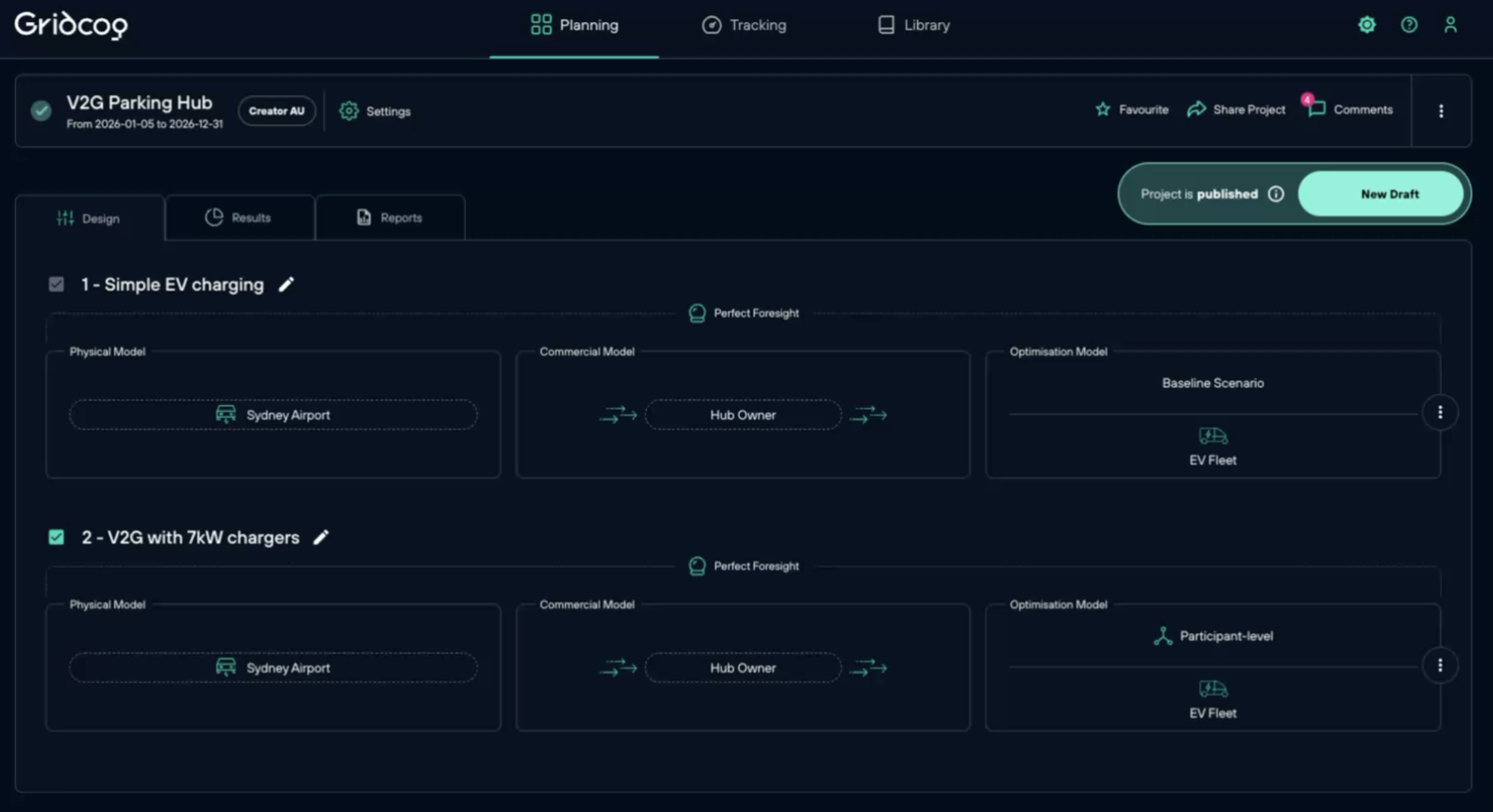
In Gridcog, I’ve built a project model with two scenarios to investigate what long-term parking providers should do with their currently under-utilised EV charging distribution boards.
The first option is pay-as-you-go EV charging using 10 x 7 kW smart chargers. We use flexibility in dwell time to control when energy is drawn from the grid, helping keep network charges low and making the most of time-of-use tariffs.
The second option puts these dormant EVs to work by installing 10 x vehicle-to-grid chargers at 7 kW each. This creates up to 70 kW of potential import and export capacity, subject to connection approval and export limits.
Key assumptions behind the V2G modelling
There are three assumptions to keep in mind for this modelling:
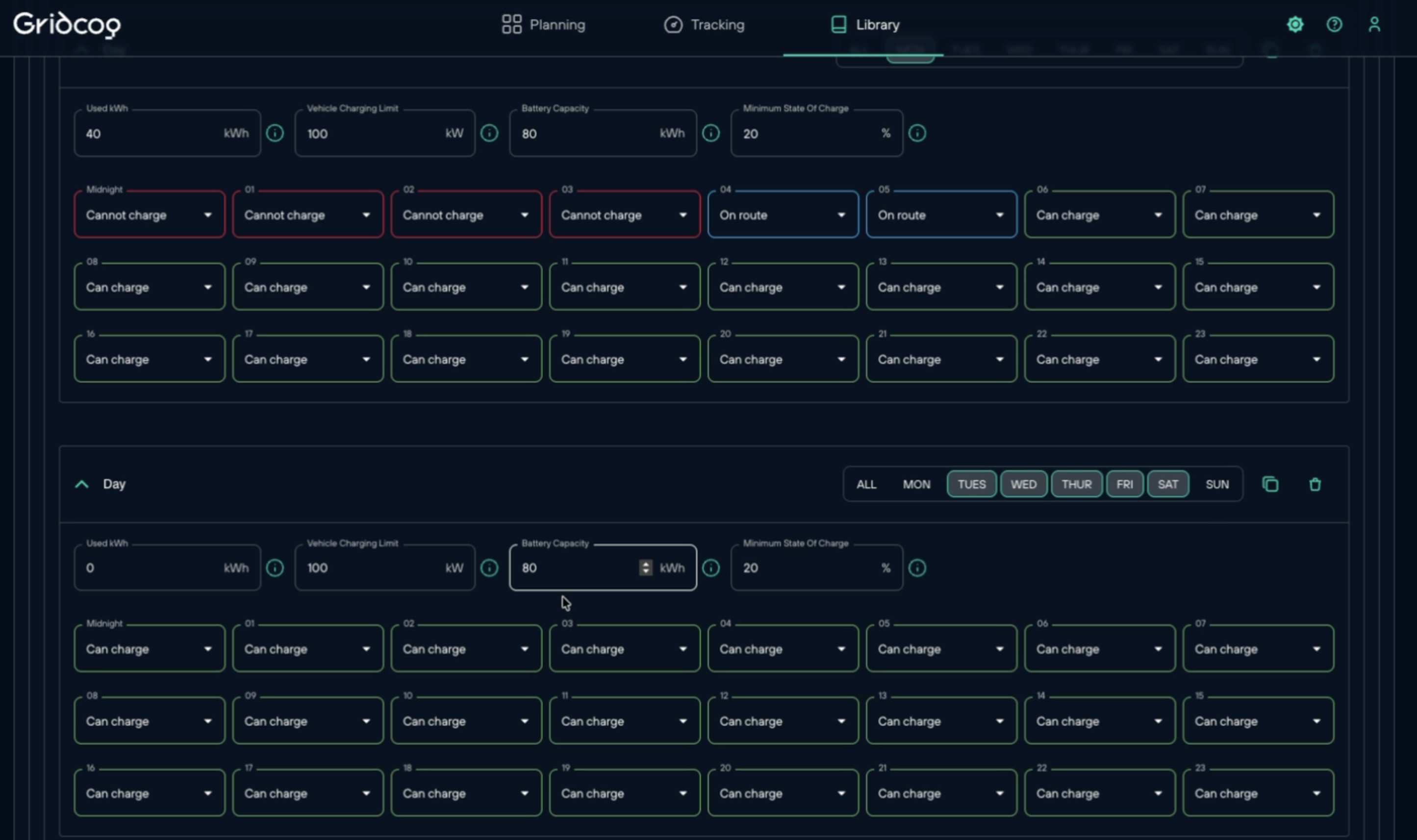
- Both scenarios are based on a long-term parking site. The charging schedules assume 10 cars arrive on Monday, occupy the chargers, and depart at the end of the week. [show schedules]??? In the first scenario, vehicles plug into smart chargers. In the second scenario, they plug into bi-directional V2G chargers.
- V2G charger costs are a key sensitivity that could shift where the commercial breakeven lands. While we expect costs to fall as demand grows, this model focuses purely on operational cashflows.The EV charging site earns revenue from customer charging fees, while the V2G site earns revenue from energy arbitrage driven by wholesale electricity price spreads.
- The two sites face different commercial exposure. The charging-only site is billed like a typical commercial and industrial load. The V2G site is assumed to have access to the wholesale energy market and a network tariff that incentivises flexibility, similar to those offered to community batteries.
Comparing charging-only and V2G cashflows
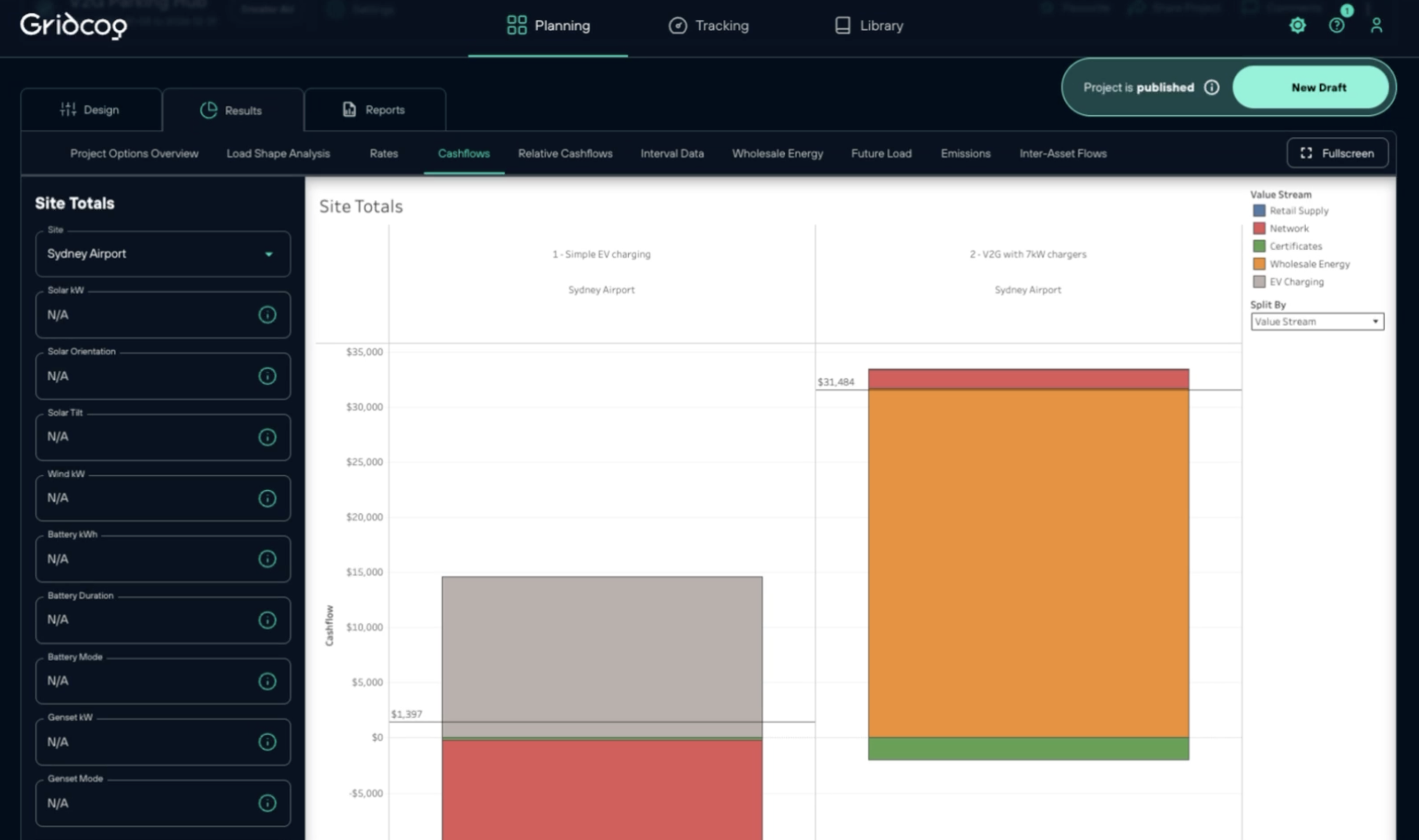
Over a year, the simple EV charging scenario remains financially positive, although network costs reduce overall revenue. In contrast, the V2G site takes full advantage of flexibility, resulting in significantly higher cash-flows.
For regular car parks, charging as a service works because high turnover drives utilisation. For long-stay car parks, utilisation is lower, and paid charging alone leaves infrastructure under-used.
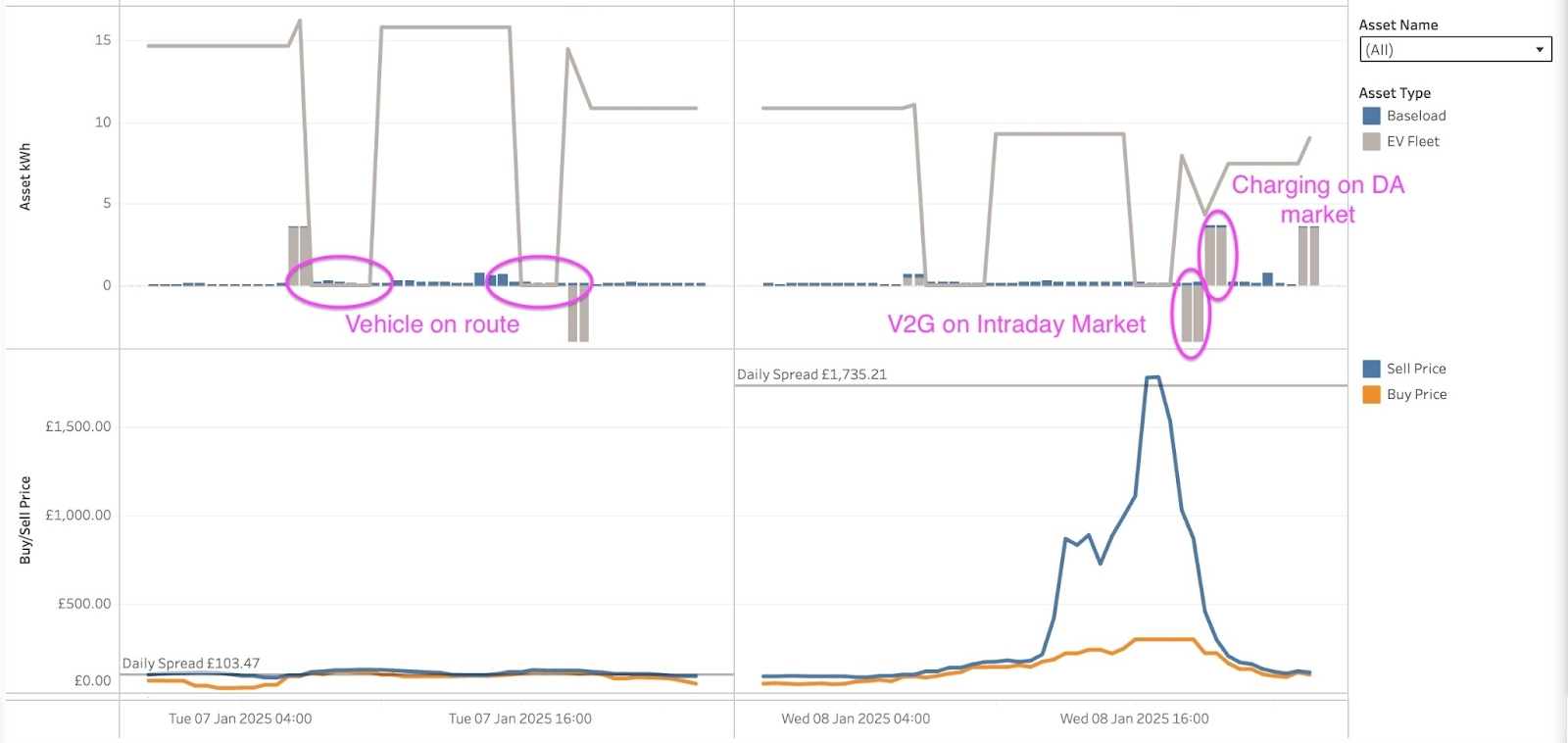
Looking at interval data from both sites, we can see how the V2G site responds to price spikes and captures daily wholesale spreads. Long-stay car parks have a natural advantage because length of stay is predictable, and that predictability is ideal for vehicle-to-grid energy arbitrage.
As departure approaches on Sunday, the battery is returned fully charged, meeting customer expectations.
What vehicle-to-grid means for long-term parking operators
This modelling also allows you to assess what compensation to offer EV owners in return for using their vehicles as flexible grid assets. Parking operators could offer free long-term parking or even a direct incentive payment for parking in a V2G bay.
Modelling these opportunities is critical before investing in EV charging or vehicle-to-grid infrastructure. With Gridcog, you can test commercial strategies, utilisation assumptions, and pricing options before you invest.