- Home
- ›
- Industries
- ›
- Data centres
- ›
- UK grid connections
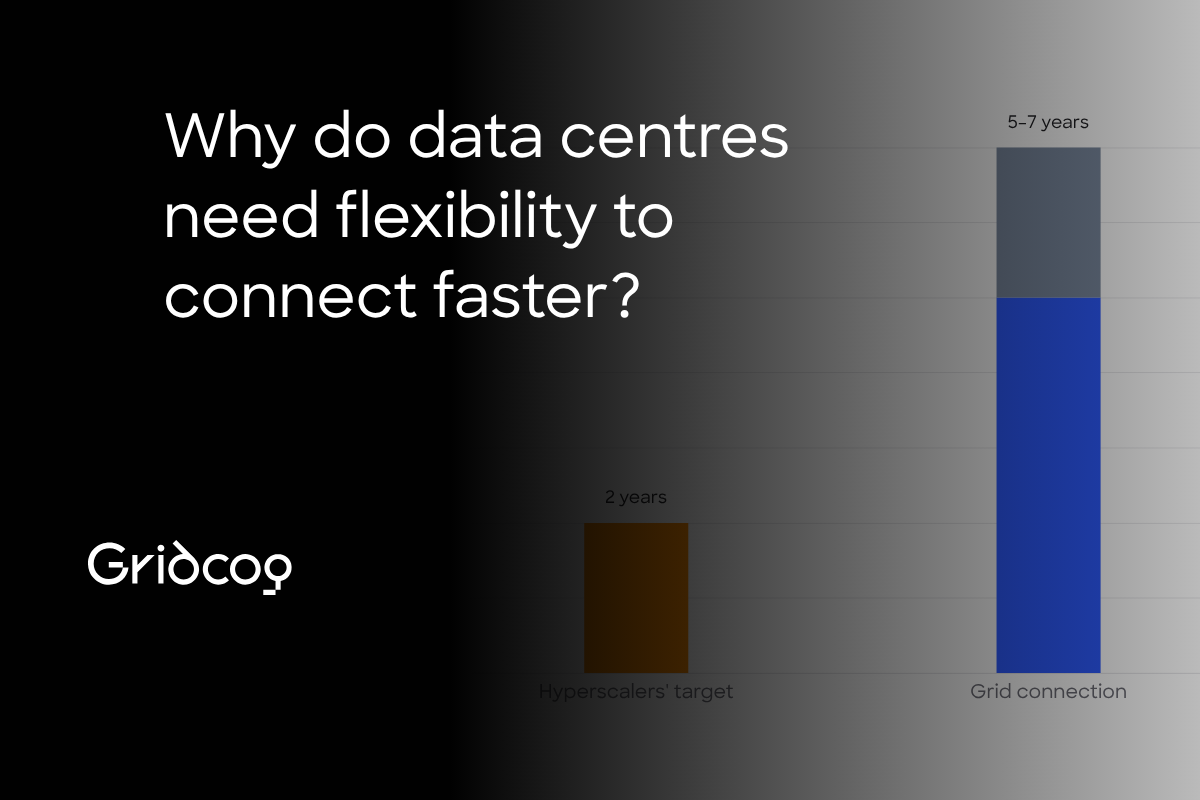
Large UK data centres now wait into the 2030s for a grid connection
Britain's demand connection queue grew from 41 GW to 125 GW in seven months, and data centres account for about 73 GW of it. Gridcog models how a battery, on-site generation and a flexible connection change your connection date and your returns, before you commit capital.


125GW
Contracted demand in the GB connection queue by June 2025, up from 41 GW
73GW
Data centre demand in that queue, across about 315 projects
2037+
Connection dates offered to some data centre developers
£47m
NPV lost when a 100 MW data centre connects three years late
Sources: Ofgem, Proposed data centre connection reforms, July 2026; Bryan Cave Leighton Paisner, June 2026; Ofgem 100 MW case study, NPV at 31 December 2026.
Why the queue is so long
Demand applications tripled in seven months
Contracted demand in the GB connection queue rose from 41 GW in November 2024 to 125 GW in June 2025. Almost all of the growth was at transmission level, which went from 17 GW to 97 GW.
Ofgem counts about 73 GW of data centres in the queue, more than GB's 45 GW peak demand. At its assumed £9.5m per MW, that implies £693bn of investment, about 23% of UK GDP, so much of it will never be built.
What a delay costs
A three-year delay costs more than the top fee
In Ofgem's case study of a 100 MW data centre, connecting in 2032 rather than 2029 cuts net present value (NPV) from £210m to £163m. The highest proposed commitment fee takes £18m off the same project.
Large transmission-connected sites applying now face dates in the 2030s, and some developers have been offered 2037 or later. Even after energisation, NESO puts the average ramp to full demand at about seven years.
What's changing
The rules that now set your connection date
NESO connections reform
Readiness sets your place in the queue
Since Ofgem approved the reform package (TMO4+) on 15 April 2025, a firm offer needs a project to be ready and needed. Data centres are deemed needed, so secured land rights or a Development Consent Order application decide it.
Ofgem proposal
A commitment fee of up to £712,500 per MW
Proposed for data centres of 40 MW and above: £237,500 to £712,500 per MW, refunded at energisation and forfeited on an early exit. Ofgem consulted until 16 September 2026 and expects to decide later in 2026.
AI Growth Zones
Five zones with priority for capacity
Oxfordshire, North East England, North Wales, South Wales and Scotland. Zones get priority network capacity, a Connections Accelerator service and, from April 2027 subject to legislation, a possible electricity price discount.
Ways to connect sooner
Four ways to get power sooner
Each one trades years in the queue against capital cost, curtailment or running cost, and the right mix depends on the site.
Connection
Non-firm or phased connection
Connect earlier and accept curtailment until the network is reinforced, or ramp your import in stages. Ofgem is developing both under its Connect workstream.
Flexible connections→Storage
Co-located battery
Covers the gap between your import limit and peak load, and earns wholesale and balancing revenue the rest of the time. Developers say AI inference peaks can cut battery life from eight years to five.
Battery modelling→Generation
On-site generation
Gas engines or fuel cells as baseload or backup. New gas demand connections typically take six to 24 months, against electricity dates that can run past 2037.
SOFC or gas genset?→Load
Flexible workloads
AI training and high-performance computing can shift in time more easily than services that run around the clock, which makes curtailment easier to live with.
Flexible loads→Test it before you commit
Model your data centre's route to power
Put the grid connection, a battery, on-site generation and the data centre's own loads in one model, behind one meter. Gridcog simulates how they run together, interval by interval, so your team can compare options side by side with every assumption visible.
Tick a scenario to add it to the model.
Scenarios as set up in a Gridcog project. Perfect foresight means the optimiser knows prices and load in advance.
UK data centre grid connections, answered
Figures from Ofgem and NESO cover Great Britain and are current at 2 November 2026. Northern Ireland has a separate system, run by SONI and NIE Networks.
Can't see your question?
Get in touch →Large transmission-connected data centres applying now can expect connection dates in the 2030s, and some have been offered 2037 or later. Distribution-connected sites are often quicker: National Grid DSO models its accepted pipeline connecting by 2032 at the latest.
The demand queue tripled from 41 GW to 125 GW between November 2024 and June 2025, mostly because of data centre applications. Ofgem counts about 73 GW of data centres in the queue, more than GB's 45 GW peak demand, and much of it is speculative.
NESO's reform, approved by Ofgem on 15 April 2025, reorders the queue so that projects which are ready and needed get firm offers first. Data centres are deemed needed, so they have to show readiness: secured land rights or a Development Consent Order application.
A proposed refundable fee of £237,500 to £712,500 per MW for data centre projects of 40 MW and above. It is paid on accepting a connection offer and forfeited if the project leaves the queue early. Ofgem expects to decide later in 2026.
A government-designated site for large AI data centres, expected to support at least 500 MW. Zones get priority for network capacity, a Connections Accelerator service and, from April 2027 subject to legislation, a possible electricity price discount.
The average UK data centre in 2025 was about 12 MW, NESO says, but projects in the connection queue range from 1 MW to 1,500 MW. NESO forecasts that UK data centres will use just over 20 TWh a year by 2030.
Often, yes. A non-firm or phased connection can come years earlier if the site can handle curtailment. A co-located battery, on-site gas generation or flexible workloads can cover the gap until the network is reinforced.
Related pages
Sources
- Ofgem, Proposed data centre connection reforms (Curate) consultation, 29 July 2026
- NESO, written evidence to Parliament (DCU0081)
- NESO, connections reform timeline
- National Grid DSO and Regen, Data Centre Impact Study, November 2025
- GOV.UK, AI Growth Zones
- Bryan Cave Leighton Paisner, The energy nexus: UK data centres and power strategy, 9 June 2026
Request a live demo
See your connection options side by side.
Bring your site, your connection offer and your load profile. We'll show you how a battery, on-site generation or a flexible connection changes your date and your returns.
The team behind Gridcog

Fabian Le Gay Brereton
Chief Executive Officer & Co-Founder
Previously co-founded Greensense, acquired by ERM Power (now Shell Energy).

Pete Tickler
Chief Product Officer & Co-Founder
Co-founded Greensense and led digital innovation at ERM Power (now Shell Energy).

Genna Boyle
Chief Commercial Officer & Head of EMEA
More than 10 years in energy strategy, trading and renewables, with senior roles at Battery Optimiser and Limejump.