

Technologies

Fleet and depot charging modelling

Fleet charging happens at depots, workplaces and homes, where operators have some flexibility in when vehicles charge. Gridcog models each vehicle's schedule, the chargers and the depot's grid connection, then compares impatient, smart and bi-directional charging. You can size chargers, storage and connection capacity before you electrify the fleet.

What is fleet and depot charging?

Fleet charging is an operator charging its own vehicles, such as vans, buses and trucks, at a depot, a workplace or drivers' homes. Because the operator knows when each vehicle is out and back, there's some flexibility in when it charges. With bi-directional chargers, vehicles can also export energy to the building, the home or the grid.

Charging modeWhat it doesEffect on costs
Impatient chargingCharges each vehicle to full as soon as it returns, at full powerUsually the highest costs, because charging ignores prices and adds to the site's peak
Smart chargingMoves charging into the cheapest periods the vehicle's schedule allows, with enough charge for the next shiftLower energy supply and network costs, and a lower peak
Bi-directional chargingSmart charging, plus discharging to the site's load (vehicle-to-building) or the grid (vehicle-to-grid)Further savings or revenue, at the extra cost of bi-directional hardware

How does Gridcog model a fleet depot?

As one site, interval by interval. Every vehicle's schedule, the chargers, the depot's existing load, the grid connection and any solar or battery sit in one simulation, and Gridcog co-optimises when each vehicle charges against the depot's supply and network costs.

01

Vehicle schedules

Enter each vehicle's daily energy use, battery capacity, maximum charge power and an hourly schedule of when it's on the road or plugged in, or upload them from the Excel template for larger fleets. Give each vehicle its own energy use to reflect different routes, with a buffer for footroom.

02

Chargers

Set charger size, number of chargers and a maximum demand across all of them. Charger capex and opex come from rate cards, so the cost of each design sits in the cashflows.

03

Charging modes

Run impatient, smart and bi-directional charging on the same fleet and schedule, and compare the cost of each. Gridcog makes sure every vehicle has the charge it needs before it leaves.

04

Grid connection, solar and storage

Apply the depot's import and export limits, including flexible connections, and add on-site solar or a stationary battery. See whether the fleet fits the connection you have before asking the network operator for more.

05

Supply and network costs

Model retail tariffs, wholesale pass-through supply and network tariffs, including demand charges. In Great Britain, test P415 market access for the depot's batteries and chargers through an aggregator.

06

Fleet transition and baselines

Phase the fleet in over time, with vehicle schedules that change from a set date and chargers added with later start dates. Add fuel costs for the current fleet as an external cost, so you can compare electric against diesel or petrol.

Modelled in Gridcog

How much does smart charging save a depot?

It can cut energy supply costs by over 63%, in Gridcog Chief Product Officer Pete Tickler's model of an eight-truck refuse fleet on Australia's east coast. He compared impatient charging, smart charging and smart charging with V2G for the same fleet at four depots.

Electric refuse truck depots, Australia's National Electricity Market (NEM)

Fleet
8 trucks, each with a 300 kWh battery and a 250 kWh daily requirement, working 5am to 3pm on weekdays
Depot
5 × 100 kW chargers; 500 kW grid import and export limit
Prices
2024 wholesale prices for each NEM region, plus the local network tariff
Strategies
Impatient charging, smart charging, and smart charging with vehicle-to-grid (V2G)
Result
Smart charging can cut energy supply costs by over 63% compared with impatient charging, depending on the depot
Range
Impatient charging cost A$169k a year at the cheapest depot, Melbourne; smart charging saved A$143k a year at Sydney
Not included
Capital costs, including the extra cost of enabling V2G; a single-year model

Electrifying a depot?

Model your fleet in Gridcog

How do you electrify a fleet on a constrained grid connection?

Genna Boyle

Chief Commercial Officer

Control when the vehicles charge before you ask for more capacity. In a Gridcog model of a small London supermarket with a battery, solar, flexible refrigeration and a delivery fleet, simple control set a peak of almost 400 kW. With the battery co-optimised and the fleet smart charging, the peak fell to around 67 kW.

That frees around 300 kW of grid connection capacity, and the same change cut the site's energy costs by nearly 10% in a year. In Great Britain, some new connection dates are more than 10 years away, so freeing capacity on an existing connection can decide whether a depot electrifies on time.

Why smart flexibility is critical to a net zero grid: insights from NESO's Future Energy Scenarios 2025

Which fleet operators use Gridcog?

Truck charging networks and energy majors use Gridcog to plan fleet electrification. Two have published how.

Rendering of an electric truck charging hub beside a motorway
Shared-use electric truck charging, Australia

NewVolt

Modelled more than 25 customer charging schedules across different duty cycles, sized battery storage for each site and tested grid connection scenarios for three 2–4 MW hubs.

‘Gridcog gave us the confidence to commit to our commercial model.’
Rainer Knobloch, Co-Founder and COO
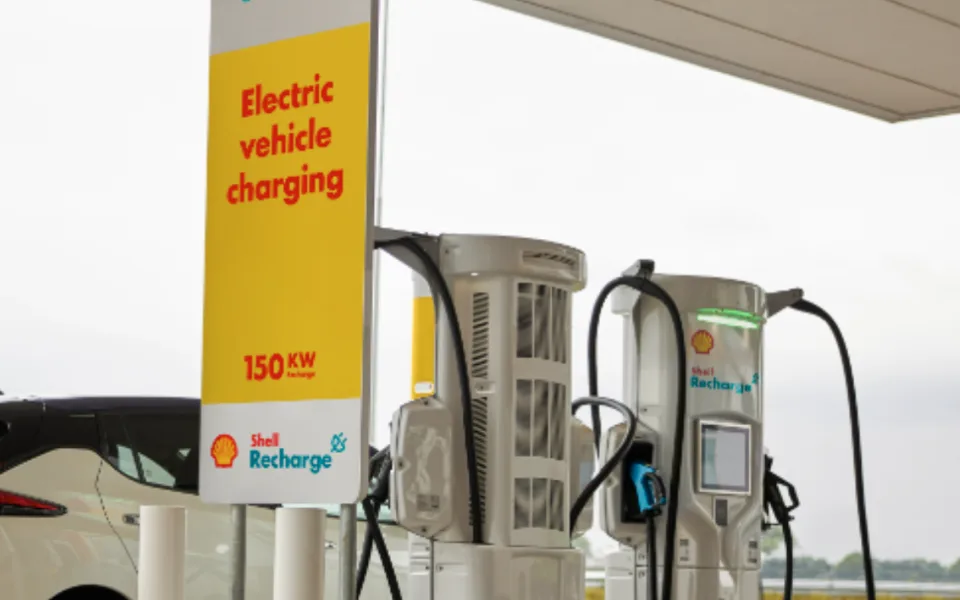
Shell Recharge fast chargers on a forecourt
Forecourt and fleet electrification, the Netherlands

Shell

Shell's e-mobility team used Gridcog to model integrated energy offerings and large-scale electrification for fleets and depots, and to explore how fleets could contribute to the bottom line through vehicle-to-grid.

Who models fleet charging in Gridcog?

Fleet operators, charge point operators, energy majors and large energy users with vehicles on site.

Frequently asked questions

Impatient charging charges each vehicle to full at full power as soon as it plugs in, whatever the price. Smart charging moves charging into the cheapest periods the vehicle's schedule allows, while making sure it has enough charge for its next shift. In Pete Tickler's model of an Australian refuse fleet, smart charging could cut energy supply costs by over 63%.

Less than the chargers' combined power, if charging is managed. Peak demand depends on when vehicles charge as much as on how many there are. In Genna Boyle's London supermarket model, smart control cut peak demand from almost 400 kW to around 67 kW. Model the fleet's real schedules first, then size the connection.

Each vehicle's daily energy use, battery size, maximum charge power and hourly schedule; the number and power of chargers; the depot's existing load and grid connection limits; and its energy supply and network tariffs. For larger fleets, upload the vehicle data from Gridcog's Excel template rather than entering it vehicle by vehicle.

Yes. Each vehicle gets its own daily energy use, battery size, charge power and schedule, so buses or trucks on different routes can be modelled together. You can add a buffer to each vehicle's minimum energy, so it has enough charge to finish its route even when the optimiser shifts charging.

Yes, with bi-directional chargers. Vehicle-to-grid (V2G) builds on smart charging by discharging vehicles when it pays, while keeping enough charge for the next shift. In Pete Tickler's Australian depot model, V2G added value on top of smart charging, though the model left out the extra cost of V2G hardware. See vehicle-to-grid (V2G).

In Great Britain, yes. Since November 2024, P415 has let owners of behind-the-meter batteries, EV chargers, generators and heat pumps appoint an aggregator to trade their flexibility in wholesale markets, separately from their supplier. Gridcog models the depot's charging, batteries and aggregator together. See demand side response and flexible loads.

Request a live demo

Model your fleet in Gridcog

Request a demo and we'll show you how Gridcog sizes chargers, storage and grid capacity for your depot.

The team behind Gridcog

Fabian Le Gay Brereton, Chief Executive Officer and Co-Founder of Gridcog

Fabian Le Gay Brereton

Chief Executive Officer & Co-Founder

Previously co-founded Greensense, acquired by ERM Power (now Shell Energy).

Pete Tickler, Chief Product Officer and Co-Founder of Gridcog

Pete Tickler

Chief Product Officer & Co-Founder

Co-founded Greensense and led digital innovation at ERM Power (now Shell Energy).

Genna Boyle, Chief Commercial Officer and Head of EMEA at Gridcog

Genna Boyle

Chief Commercial Officer & Head of EMEA

More than 10 years in energy strategy, trading and renewables, with senior roles at Battery Optimiser and Limejump.